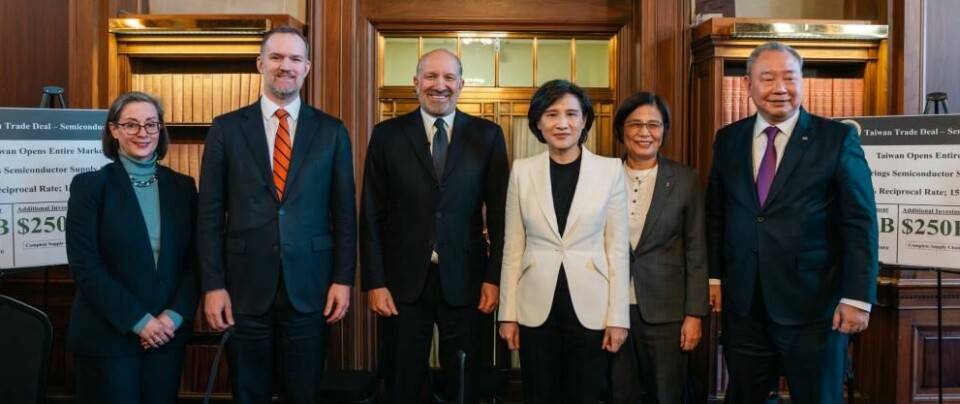
Taiwan to face lower tariffs and invest in US chip manufacturing in new trade deal as US introduces 25% global semiconductor tariff
The US has announced it has agreed a trade deal with Taiwan, offering lower tariffs in return for investment from Taiwanese chipmakers in expanding US semiconductor manufacturing operations. Meanwhile, the US government has classified the import of both semiconductor chips and critical minerals as national security risks, and has imposed an additional 25% global tariff on the import of certain semiconductors.
Data shows that the US imported $11.9 billion worth of semiconductors from Taiwan in 2025Grok AI
On 15 January, 2026, the US Department of Commerce announced
that the American Institute in Taiwan and the Taipei Economic and Cultural
Representative Office in the United States had signed a “historic” trade deal,
which will see Taiwanese semiconductor and technology companies invest in manufacturing
on US soil, as well a reduction in the tariffs imposed by the US on imports from
Taiwan.
The American Institute in Taiwan and the Taipei Economic and Cultural Representative Office in the United States reached a trade agreement on January 15, 2025US Department of Commerce
As per the agreement, Taiwanese semiconductor and technology
enterprises will make new, direct investments totalling at least $250 billion
to build and expand advanced semiconductor, energy and AI production and
innovation capacity in the US.
Additionally, Taiwan is set to provide credit guarantees of
at least $250 billion to facilitate additional investment by Taiwanese
enterprises, supporting the establishment and expansion of the full
semiconductor supply chain and ecosystem in the US.
Meanwhile, Taiwan will also facilitate US investment in Taiwanese
industries including semiconductors, AI and telecommunications in order to “expand
market access for American companies, deepen technological collaboration, and
strengthen US leadership in critical and emerging industries”.
The US Department of commerce said this deal will “drive a
massive reshoring of America’s semiconductor sector”, while strengthening US
economic resilience, creating new high-paying jobs, and bolstering US national
security.
In return for its commitment to invest in US semiconductor
manufacturing, Taiwan is set to benefit from reduced tariffs on goods exported
to the US. The agreement sets out that the US reciprocal tariff rete applied to
Taiwanese goods will not exceed 15% and the US Section 232 duties applied to
Taiwanese auto parts, timber, lumber and wood derivative products will likewise
not exceed 15%.
Furthermore, the deal set precedent that Taiwanese companies
investing in the US will be rewarded with tariff exemptions. Those building new
semiconductor capacity in the US will be allowed to import up to 2.5 times the
planned capacity without paying Section 232 duties during the approved
construction period, with a lower preferential Section 232 rate for above-quota
imports.
After the completion of a new project, these companies will
continue to benefit from Section 232 duty exemptions for up to 1.5 times their
new US production capacity.
In the short term, tier-one suppliers in the US will be able
to benefit from lower import duties for Taiwanese semiconductors, dropping from
20% to below 15%.
According to market research, the automotive sector spends
around $60 billion on semiconductors annually, and Taiwan is believed to
account for over 60% of global semiconductor production.
In the 2025 KPMG Global Semiconductor Industry Outlook
Survey, 60% of respondents identified the prominence of Taiwan in the
semiconductor supply chain as an area of high concern over the next two years.
In the longer term, OEMs and tier suppliers in the US may
benefit from additional investment into the US’ domestic semiconductor
manufacturing industry. If the US’ semiconductor output increases, it’s
possible automotive companies in the US could reduce reliance on imports –
boosting resilience – and even reduce costs associated with international
transport of chips.
Semiconductors and critical minerals labelled national security risks
As the Trump administration in the US continues to introduce
and adjust trade measures part of its policy to prioritise domestic
manufacturing and “put America first”, US president Donald Trump’s latest proclamations
have declared both semiconductor and processed critical mineral imports as a “serious
risk” to the US’ national security.
These actions came as the US secretary of commerce Harold
Lutnick concluded investigations into the import of these goods into the US,
recommending a new tariff for semiconductors and the pursuit of new agreements
for critical mineral imports to “address the threatened impairment of the
national security”.
On January 14, 2026, Trump issued a proclamation in response
to a report from Lutnick in December 2025 which advised that “semiconductors,
semiconductor manufacturing equipment and their derivative products are being
imported into the United States in such quantities and under such circumstances
as to threaten to impair the national security of the United States”.
The report noted that the US’ semiconductor manufacturing capacity
is “too low” to meet projected national defence needs and match growing
commercial requirements. It found that the US consumes approximately one
quarter of the world’s semiconductors but currently only manufactures 10% of
the chips it needs domestically.
Upon Lutnick’s recommendation, the White House has outlined
a two-phased approach for addressing this issue. This begins with a 25% tariff
on “a very narrow category of semiconductors” that relate to the US’ AI and
technology policies as trade negotiations with foreign jurisdictions continue,
then – once negotiations have concluded – broader tariffs on semiconductors
will be introduced “at a rate of duty that is significant” alongside measures
to offer preferential tariff treatment to companies investing in US
semiconductor production.
This initial 25% tariff has already come into effect as of
January 15, applying to “certain advanced computing chips” such as the NVIDIA
H200 and AMD MI325X, which are large AI accelerator GPUs designed for high-performance
computing and AI model training in data centres. The White House noted that the
tariff will not apply to chips that are imported to support the buildout of the
US technology supply chain and the strengthening of domestic manufacturing
capacity for derivatives of semiconductors.
The implementation guidance published by US Customs &
Border Protection makes clear that certain end uses are exempt from the
additional 25% duty, including imports of semiconductors for use in automotive
applications. So while the tariff does not yet apply to semiconductors for
automotive manufacturing, these may be impacted If the US moves to the second
phase of its approach which promises broader tariffs on semiconductors.
While some OEMs such as Ford and Tesla operate data centres
in the US and may import advanced computing chips, the phase-one semiconductor
tariff explicitly exempts chips used in US data centres, meaning these
companies are also unlikely to be directly affected.
In a separate proclamation, Trump also announced that
Lutnick’s investigation into critical minerals found that these import goods
are also a threat to national security due to the US’ reliance on foreign
countries for these minerals. Trump has claimed the US government will now seek
to reach agreements with other nations to manage trade of critical minerals
and, while no tariffs have initially been imposed, he has suggested that such
actions may be deemed necessary if agreements are not reached in a timely
manner.