European Commission’s Joint Research Centre submits proposal on harmonised waste sorting labels under PPWR
A new technical proposal published by the European Commission’s Joint Research Centre (JRC) has put forward plans for a single waste-sorting label system under the Packaging and Packaging Waste Regulation (PPWR) – a new EU law which entered into force on February 11, 2025 and is due to take full effect in August 2026.
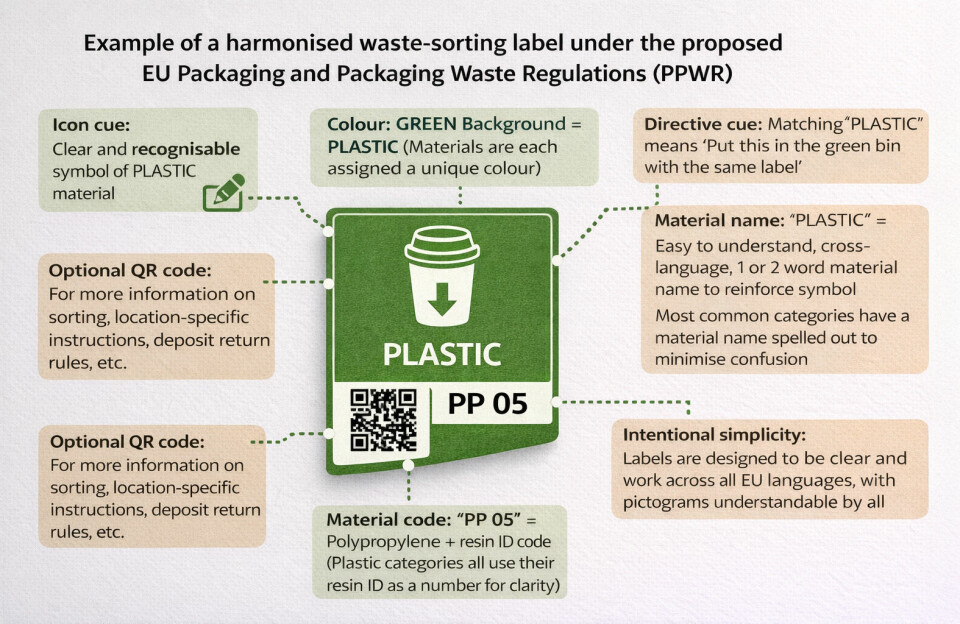
An AI-generated example of how a harmonised packaging label could look, with elements outlined in the JRC's proposal
ChatGPT
The JRC proposal, based on “theoretical, conceptual and
empirical research in behavioural and participatory design conducted between
2023 and 2025” suggests that one common label system is used on packaging consistently
throughout EU member states, rather than varying from country to country.
These labels, it proposes, should focus on the material of
the packaging and be placed across the EU on packaging and the relevant bins.
The JRC recommends that the labels should use clear pictograms and little-to-no
text in order to be as accessible as possible across countries with different
languages.
This system would apply to all forms of packaging, not just
consumer packaging, meaning that industrial packaging and transport and
logistics packaging would need to conform to these rules should the proposal be
implemented.
Another recommendation the JRC makes is that packaging consisting
of multiple materials (for example a cardboard box sealed with plastic wrap)
have either two separate labels for each part or a single label showing how each
part can be separated.
This is especially relevant within the context of industrial
and logistics packaging, which is often made up of several separable materials
handled by numerous different people throughout the supply chain. These
materials must be separated correctly on site to avoid contamination, support
recycling initiatives and meet waste management obligations in factories,
warehouses and logistics hubs.
An additional QR code could then perhaps provide further information, such as location-specific sorting instructions, but the proposal clearly states that the harmonised label should function without relying on digital tools to convey essential sorting information.
If such labels do become mandatory as part of the PPWR
implementation this year, automotive supply chains with operations in
Europe will need to adhere to EU requirements. This will mean labels need to be
applied to pallets, plastic crates and trays, films and protective wraps, as well
any other packaging used in the transportation of vehicles, auto parts or raw
materials.
To keep costs down and adhere to requirements, it may be
that companies moving goods work with their packaging providers to simplify the
combination of materials used in packaging production and improve the recyclability
of packaged used in automotive supply chains.
Redesigning packaging would obviously come at a cost, but in
the long term this could simplify end-of-life processes for packaging across Europe.