In ASEAN's automotive supply chain, reliability is the new speed
Chinese competition, shifting trade rules and persistent disruption are turning logistics from a cost to be minimised into a source of competitive advantage in South-East Asia. On day one of Automotive Logistics & Supply Chain ASEAN in Kuala Lumpur, OEM, supplier, logistics and policy leaders argued that predictable lead times, trusted partnerships and simpler regional rules matter as much as raw speed, and set out what Malaysia needs to strengthen its role as a regional hub.
Thayalan Subramaniam, general manager and head of sales and customer solutions at MAN Truck & Bus (M) Sdn Bhd (centre), and Maung Ye Lay, general manager of aftersales parts, regional SCM, at Isuzu Motors Asia (right)Source: Automotive Logistics
Much of the industry's attention in South-East Asia is fixed on the pace of Chinese carmakers. Opening the event on October 27, Christopher Ludwig, chief content officer at Automotive Logistics, described "China speed" as a force reshaping not just market share but how logistics and supply chains work, from faster responses to requests for quotation (RFQs) to shortened development cycles.
Yet one of the clearest messages from the day's panels was that, for many manufacturers in the region, predictability counts for at least as much as velocity. Rizal Abu Bakar, director of parts distribution centre at BMW Group Malaysia, said parts planning depends on transit times that can be relied on, rather than the fastest ones on offer. "If the sea freight is coming every time in six weeks, it's much easier for us to plan," he said, compared with a route that arrives in four weeks one time and eight the next. "Every single planning relies on lead time."
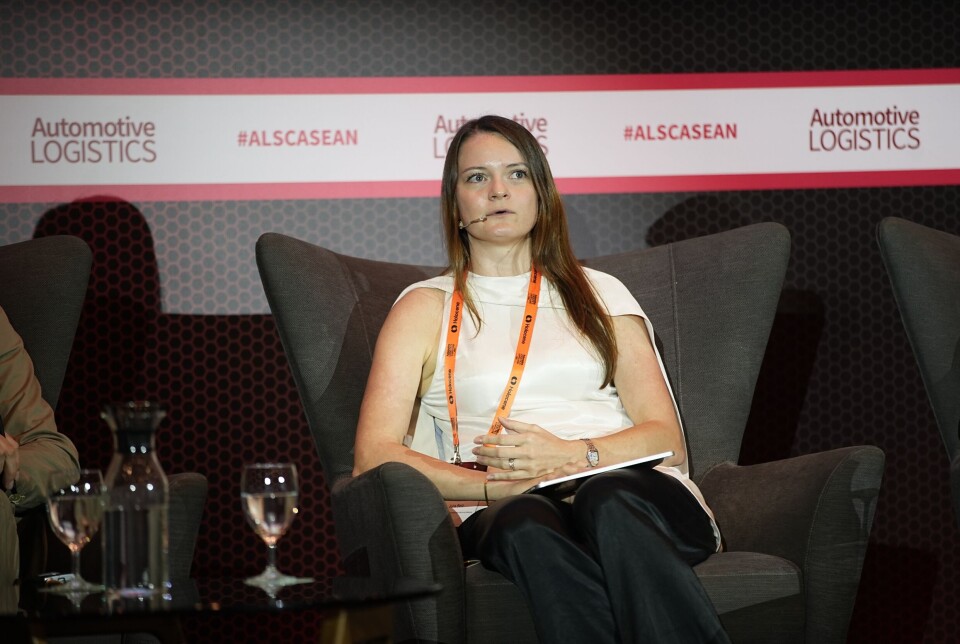
Dominik Birth-Ruszczynski, director after sales, APAC at Volkswagen Group Regional After Sales, applied the same logic to choosing logistics providers. "A partner who is really capable of absorbing a bad week is more valuable than the one that is 1% cheaper," he said.
From cost centre to differentiator
Advertisement
Several speakers described a shift in how supply chains are valued. David D'Annunzio, global vice president – vertical lead, automotive at DP World, said that when he started in the industry the supply chain was treated as an expense to be minimised. With competition intensifying and disruptions continuing, he does not expect conditions to ease anytime soon. The priority now is to avoid interruptions. He cited a saying in the US market: “Sales sells the first car; service sells every car thereafter.”
Abu Bakar made a similar case. His distribution centre, which serves more than 20 countries in Asia-Pacific, achieves a service level above 90%, he said, yet BMW keeps investing in forecasting and inventory management because parts availability drives uptime and loyalty.
For Marc Appelt, managing director of MAN Truck & Bus (M) Sdn Bhd, the shift has been sharpened by Chinese truck makers, which he said have taken a substantial share of a heavy-duty segment European brands once dominated. Because MAN cannot match Chinese purchase prices, Appelt said it is competing on uptime and operating costs, including fuel efficiency, and continues to expand its Malaysian service network with private dealer capital. For MAN, the reliability of logistics and service is now part of what it sells.
Policy churn and the end of just-in-time
If competition is raising the stakes, regulation is raising the complexity. Jai Pal Singh, head of regional operations at Harley-Davidson Motor Company, said trade wars and growing protectionism have forced OEMs to de-risk, moving away from just-in-time (JIT) supply towards what he called "just in case", with larger inventories and more active risk management. "JIT is no more successful in these scenarios when things are changing very rapidly," he said.
Maung Ye Lay, general manager of aftersales parts regional SCM at Isuzu Motors Asia, said that while ASEAN is leading on unifying flows across countries, import regulations increasingly diverge at Harmonised System (HS) code level, with growing requirements for local production and certification. The pace of new rules raises immediate questions, he said, from what happens to shipments already on route to whether existing documentation will still be accepted.
Marc Appelt, managing director, MAN Truck & Bus (M) Sdn BhdSource: Automotive Logistics
Appelt urged policymakers to "do the basics first". Trucks travelling from Malaysia into Thailand must decouple the trailer at the border and pick up a new prime mover, he said. "This doesn't make sense at all." Vehicle homologation is another source of friction. Appelt said type-approval rules differ from country to country, change frequently and are not always transparent, which makes the time and cost involved hard to plan. Bringing in the same engine with ten more horsepower, for example, means going through type approval again. His logistics customers also complain about the upkeep of Malaysia's roads, he added, where potholes add repair costs and take trucks out of service. By his estimate, 48% of trucks on Malaysian roads run without cargo, which raises costs and emissions for every load that is carried.
The final panel of the day returned to the same problem. Sugumaran Muniappan, head of procurement and product development at Tan Chong Motor, named regulatory harmonisation as the biggest barrier in what remains a fragmented ASEAN market, citing inconsistent customs clearance, a shortage of talent in advanced logistics functions and congestion when cargo builds up at peak periods.
Advertisement
Localisation, but done intelligently
Localisation emerged as both a policy requirement and a competitive response. Thayalan Subramaniam, general manager and head of sales and customer solutions at MAN Truck & Bus (M) Sdn Bhd, explained that MAN ships trucks as completely knocked-down (CKD) kits from Salzgitter in Germany and from Poland, exposing it to geopolitical delays. He said Malaysia is close to no longer allowing semi-knocked-down (SKD) imports, with the Ministry of Investment, Trade and Industry (MITI) setting requirements for which components must be localised, and that developing a local supply base remains a "chicken and egg" problem for lower-volume manufacturers.
Singh cautioned against equating speed with success. "Winners are not the ones who actually do the localisation very fast," he said, arguing for "intelligent localisation" that protects cost, quality and standards. Sugumaran described Tan Chong's approach in similar terms as "smart localisation". The company would like to localise critical electric vehicle (EV) components such as inverters, motors, generators and batteries, he said, but each requires significant volume, technical support from the principal and a thorough return-on-investment study before the case stands up.
Julia Betz, general director and head of plants Malaysia, Dräxlmaier GroupSource: Automotive Logistics
Appelt said MAN will localise further in the region while keeping the engine, axle and gearbox in Europe. D'Annunzio described a familiar pattern from other developing markets, in which tyres, batteries, glass and seats are localised first and manufacturing follows once volumes justify it. D'Annunzio added that when Japanese carmakers came into the region their suppliers followed, and he expects the same of Chinese OEMs.
Suppliers are waiting for clearer signals before committing. Julia Betz, general director and head of plants Malaysia at Dräxlmaier Group, said the company has EV production in Thailand but not yet in Malaysia, and that battery assembly would require heavy investment in clean rooms and fire safety that suppliers and OEMs could not carry without support. She pointed to the automotive policy, government budgeting and recent minimum wage increases as factors weighing on investment decisions. "The transparency needs to be given on policies," she said. "The demand must be here."
Mohd Sharulnizam Sarip, chief technology officer at the Malaysia Automotive, Robotics & IoT Institute (MARii), which advises MITI under the National Automotive Policy (NAP), acknowledged the tension. "We need to be realistic in terms of economy of scale," he said. Incentives such as the Industrial Linkage Programme (ILP) have to be targeted at the capabilities Malaysia most needs, he explained, rather than spread across every activity, while shared research and development services and soft loans for advanced manufacturing technology are intended to lower suppliers' overheads.
Malaysia as a regional gateway
The final panel examined how far Malaysia can serve as a hub for the wider region. Volkswagen Group runs a regional distribution centre at the Port of Tanjung Pelepas (PTP) in Johor that serves 20 markets, and Birth-Ruszczynski said the group chose Malaysia for its space, infrastructure and competitive logistics costs, with Singapore adding air freight connectivity and frequency. Because all the major logistics providers operate in Malaysia and Singapore, he said, reliable partners are easy to find. The location also comes with friction. PTP is a transhipment hub, so less-than-full containers have to move through Pasir Gudang or Singapore, and the causeway into Singapore can add delays. Johor and Singapore also compete for the same logistics workforce, he said, with wages rising and data centres adding to the demand for staff.
Advertisement
Sugumaran pointed to connectivity between ports in the north, centre and south of the country, a skilled workforce and an established supplier ecosystem as Malaysia's main strengths. Sharulnizam said MARii is working to bring the NAP, the New Industrial Master Plan, the Intelligent Transportation System and the National Transport Policy, which sit under different ministries, onto a single platform to speed up clearance for industry. Expert working groups on automotive products and land transport are also pursuing closer alignment at ASEAN level, he added.
Panellists described resilience as a choice between costs. Birth-Ruszczynski said Volkswagen holds stock for the relatively small number of parts that keep vehicles off the road, accepting that this ties up capital, and keeps a prequalified alternative carrier on standby. "When a disruption happens in automotive and aftersales, freight does not matter. Time matters," he said. Betz said Dräxlmaier's low-volume CKD production carries little stock, so when sea freight is delayed the company pays to expedite materials. "In the end, the customer shouldn't feel it," she said.
Batteries test cross-border rules
EV batteries showed most clearly what fragmented regulation costs. Birth-Ruszczynski said the battery "changes basically everything" in aftersales logistics, and that the shift to EVs will remove roughly 40-50% of parts volume. Warehouses have to be designed around the risk of a thermal event, with detection planned before suppression, and staffed by high-voltage technicians. The same part number can arrive as a normal, returned, damaged or quarantined battery. "Four different legal aspects, same part number, but unfortunately they cannot share the same shelf," he said. A damaged battery cannot be flown, returning one from Australia to Malaysia needs approval from every country along the way, and the decision on its condition is made by a workshop technician rather than by logistics. With each country applying its own dangerous goods rules, he called for a common way of assessing batteries that is recognised across borders.
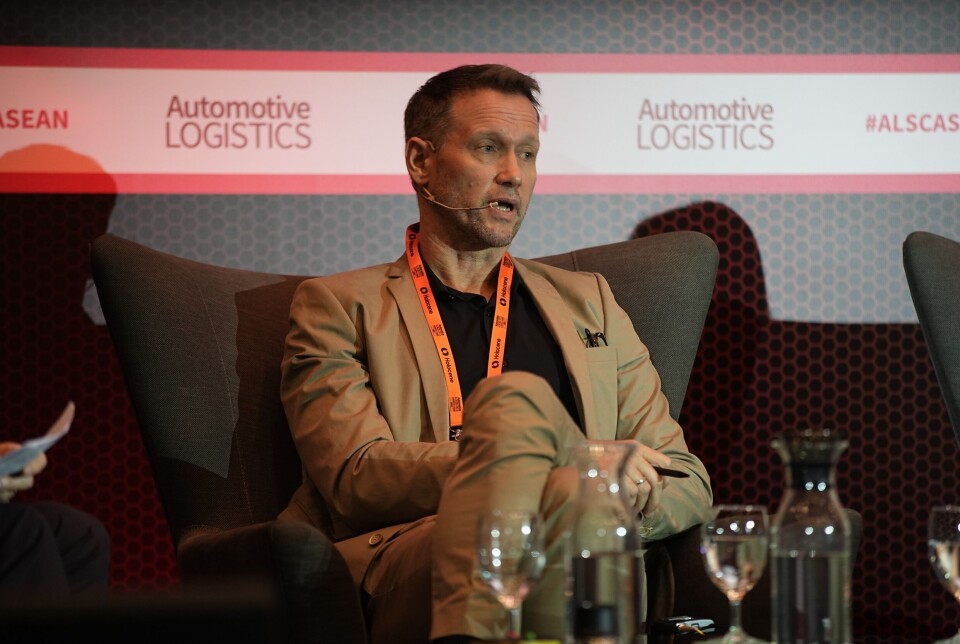
Dominik Birth-Ruszczynski, director after sales, APAC, Volkswagen Group Regional After SalesSource: Automotive Logistics
Sharulnizam said the ASEAN battery passport, launched during the ASEAN chairmanship last year, will bring handling, safety certification and first-responder information onto one platform. Malaysia's standard, MS 2818, has been benchmarked against EU rules and covers around 73 parameters, and the government is considering incentives for OEMs that comply, he said. Birth-Ruszczynski welcomed the initiative, but urged that it be matched to the EU passport, which becomes mandatory in February 2027, so that manufacturers and logistics providers are not left managing two sets of data. His priority for the year ahead is a qualification and certification pathway for handling high-voltage batteries that is recognised in Johor, Jakarta and Bangkok alike. "At the end, all the challenges that we have, it's about people," he said.
Partnerships built on data and trust
D'Annunzio argued that buying each leg of a supply chain separately carries hidden costs, much like staff turnover, and no longer works amid constant disruption. He suggested OEMs contract an entire supply chain to one provider, with alternative providers managing back-up routes so they are not "putting all your eggs in one basket". Abu Bakar favoured long-term partnerships over bundling, arguing they give both sides the confidence to invest.
Singh pointed to Catena-X as a model for visibility down to tier three and four suppliers, while stressing that collaboration rests on transparency and keeping promises. In the final session, Sugumaran and Sharulnizam both named integrated, accurate data sharing across suppliers, logistics providers and government as their top priority, while Betz called for government agencies, manufacturers, suppliers and logistics providers to decide together which capabilities Malaysia should develop next.
Appelt said inbound reliability remains a weakness. Each MAN kit passes through production in Europe, ocean freight, customs agents and several warehouses before reaching the assembly line, and he said too many arrive late, leaving customers without revenue-earning trucks. Full transparency across that chain is what he needs most.
Getting the basics right
Across the day's sessions, speakers returned to a short list of priorities. They want regulation that is simpler and more transparent, and standards such as battery handling that are recognised from one country to the next. They want localisation sized to volumes that can support it, logistics partnerships long enough to justify investment, and data that partners trust enough to share. ASEAN's growth is forecast to continue, but on the evidence of day one, the companies that benefit most will be those that can make their supply chains predictable.
Market snapshot
Figures from Mobility Global (data compiled October 2026), presented by Christopher Ludwig in his opening address, and from Automotive Logistics Intelligence research.
Light vehicle sales across the ASEAN-5 are forecast to grow at a compound annual rate of 4.1% between 2026 and 2033, from around 3.5m units to 4.6m
Indonesia is expected to become the first ASEAN market to pass 1m annual sales, in 2028, with Thailand following in 2032. Philippine sales are forecast to dip in 2026 on inflation and energy prices
Regional production is forecast to grow by around 4% a year to 2033. Indonesia closes the gap with Thailand, with both approaching 1.8m units by 2033, though Thailand remains the larger export hub while Indonesian output is driven by its home market
Malaysian production is forecast to rise from around 757,000 units in 2025 to roughly 867,000 by 2033, while domestic sales hold broadly flat at just over 800,000
Vietnam is the region's growth engine, with production forecast to rise from around 365,000 units in 2025 to more than 620,000 by 2033, supported by VinFast's expansion and EV adoption
Chinese OEMs' share of ASEAN light vehicle production is forecast to rise from 5% in 2025 to around 23% by 2033, while Japanese OEMs' share falls from 65% to 49%
Mobility Global flags overcapacity as the leading risk for Chinese OEMs in the region, which have around 1m units of capacity, battery electric vehicle (BEV) plant utilisation below 20%, US$17.7bn of investment pledged since 2021, and 22–23 brands each in Thailand and Indonesia, up from three in 2021
Local content rules are tightening. Thailand's EV3.5 scheme requires three locally built vehicles for every completely built-up (CBU) import by 2027, and Indonesia plans to raise minimum local content from 40% to 80% by 2030
Automotive Logistics Intelligence estimates the core ASEAN automotive logistics market at around $11bn, growing to close to $17bn within five years