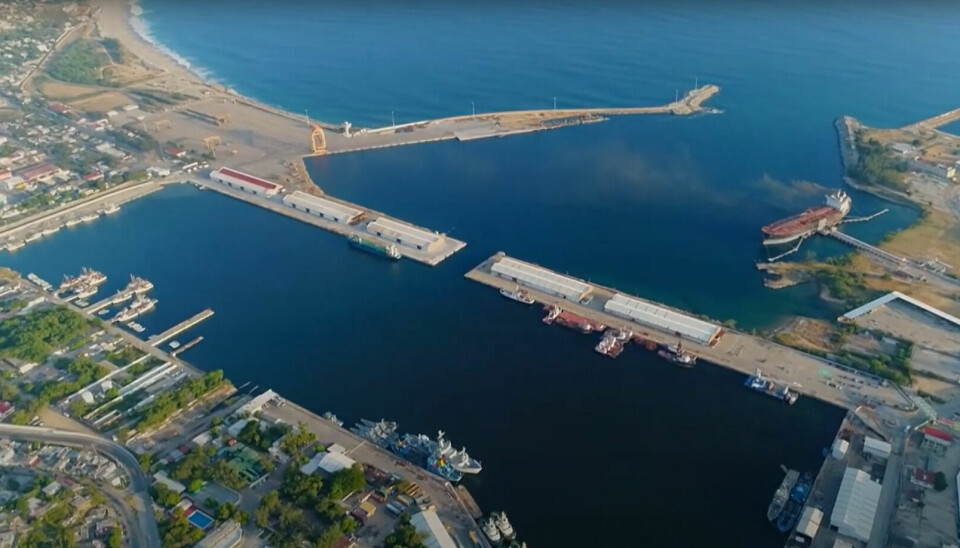
Logistics infrastructure in Mexico
Mexico’s Interoceanic Corridor of the Isthmus of Tehuantepec set for completion in 2026
A major infrastructure project linking the Pacific and Atlantic oceans is already operational and is set for full completion in June 2026. The Interoceanic Corridor of the Isthmus of Tehuantepec is intended as an alternative to the Panama Canal, taking advantage of Mexico’s upgraded rail network.
Speaking in February 2025, Mexico’s president Claudia Sheinbaum said that she expects the CIIT to be complete by June 2026
Mexico Projects Hub
According to the Mexican government, the Interoceanic
Corridor of the Isthmus of Tehuantepec (CIIT) aims to implement a multimodal
logistics platform that integrates the services provided by Mexico’s National
Port System and local administrations, interconnected through rail transport
via the Isthmus of Tehuantepec Railway.
The project was officially approved in June 2019 and, in February
2025, Mexico’s president Claudia Sheinbaum confirmed that the CIIT is due to be
fully completed in the first half of 2026, with final construction works set to
finish in June this year.
An alternative to the Panama Canal
The CIIT is expected to serve as an alternative to the
Panama Canal, which Sheinbaum has described as “saturated”.
“The Isthmus of Tehuantepec is the best route to go from the
Pacific to the Atlantic and vice versa,” Sheinbaum said in a press conference
last year. “Even with all the new tariff situation, there will continue to be
world trade from Asia to Europe and vice versa.”
In June 2025, it was reported that, according to Alphaliner
data, Panama Canal container ship traffic hit an all-time high for the first
five months of the year, with around 1,200 vessel transits recorded in each
direction.
By taking advantage of Mexico’s railways, it is possible to
eliminate the need to transit the Panama Canal for certain shipments,
potentially reducing congestion and providing an alternative should there be
any issues with shipping via the Panama Canal.
“We have never experienced a Panama Canal shutdown, but we thought
that we were never going to see the Suez
Canal being shut down, and we experienced that,” Sergio
Gutierrez, COO at Glovis America observed while speaking at the Automotive Logistics &
Supply Chain Mexico conference in 2025. “The whole point is talking about
bold innovation and bold infrastructure. This is the kind of thing that we
should be getting together to discuss.”
He noted that “it might be too soon to suddenly shift
everything into that”, but claimed that over the next few decades, more of this
kind of infrastructure will be necessary to ensure continued growth, both for
Mexico and for the automotive logistics sector.
Hyundai trials CIIT with pilot shipment
In early 2025, Hyundai Glovis – logistics and shipping
subsidiary of Hyundai Motor Group – conducted a pilot shipment, moving 900
vehicles using the CIIT rail line. Its ‘Glovis Cosmos’ ship travelled across
the Pacific Ocean from South Korea to Port of Salina Cruz in Oaxaca, Mexico –
via the Port of Lázaro Cárdenas.
From there, all 900 vehicles were unloaded and were
transported using Isthmus of Tehuantepec Railway to the Port of Coatzacoalcos,
Veracruz, on Mexico’s east coast. They were transported in two batches – one
with 600 vehicles and a second with 300 – using 50 Bi-Max freight cars along
the railway's Line Z.
Once in Veracruz, the vehicles were loaded onto the ‘RCC
África’ vessel, which then set off for the Brunswick, Georgia, on the east
coast of the US. Each shipment reportedly took around nine hours to cross Mexico
via rail, with the entire Mexico segment of the journey taking a total of six
days.
Glovis America’s Sergio Gutierrez told the audience at ALSC Mexico
2025 that this pilot was conducted with the intention of validating the feasibility
of using the CIIT, rather than the Panama Canal, to move vehicles between the
Pacific and the Atlantic Ocean.
“We would like to think not about what is going to happen tomorrow with our
tomorrow's P&L – I'm talking about what is going to happen with the future
of Mexico and the entire industry in the next 30-50, if not more, years,”
Gutierrez said.
“It’s just like when the Panama Canal was created – many
generations were not able to see the benefit, and nowadays we all use it,” he
added. “So this interoceanic corridor will be a generational game changer for
Glovis.”
Implications for the automotive supply chain
As the CIIT nears completion, its potential to impact automotive supply chains remains to be seen, but the Hyundai pilot proves at the very least that it is possible to move vehicles along the CIIT from one side of Mexico to the other. It’s only through more projects like this that the viability of this corridor as an alternative to the Panama Canal will become apparent.
In 2023, Raquel Buenrostro, then-minister of economy for Mexico, stated that the Mexican government had met with major automotive OEMs including Toyota and GM to discuss opportunities to invest in the interoceanic corridor. Both companies confirmed they held talks around the project, but neither has announced any investment plans since. Automotive Logistics will continue to monitor the situation as infrastructure works on the corridor progress.