Moving at Mexico speed: how Nissan, GM and Volkswagen are redesigning flows in Mexico
At ALSC Mexico 2026, Nissan, GM and Volkswagen outlined how greater local decision-making, closer collaboration with logistics partners and more flexible supply chains are helping them adapt to changing production and trade flows.
James McLoughlinJamesMcLoughlinAssistant Editor - Automotive Logistics
Published
6 min
The Mexico in motion panel at Automotive Logistics & Supply Chain Mexico 2026. (L to R) Christopher Ludwig, Automotive Logistics; Dayan León, Nissan; Monica Garcia, GM; Alexandra Olvera, Hellmann; Antonio Zepeda Torres, CSI GroupALSC Mexico 2026
In Mexico City this week, Automotive Logistics & Supply Chain 2026 got underway, kicking off two full days of conference sessions with a range of industry experts from all across Mexico's automotive supply chain.
As Automotive Logistics' chief content officer Christopher Ludwig highlighted in his opening remarks, Mexico's automotive logistics industry is facing a period of structural change. Tariffs and trade uncertainty – particularly surrounding the future of the US-Mexico-Canada Agreement (USMCA) – alongside increasing logistics costs, Chinese competition and an increased emphasis on localisation, are contributing to the high-pressure environment that automotive companies in Mexico are having to navigate today.
The question is no longer simply how to move existing production volumes efficiently, but rather how to accommodate changing manufacturing locations, supplier networks and international flows.
Throughout the first day of the conference, the insights shared by three leaders in particular, each representing one of the major OEMs operating in Mexico – Nissan, GM and Volkswagen – spoke to the transformative changes that are currently reshaping automotive supply chains across the region.
In one of ALSC Mexico's opening sessions, Dayan León, deputy director of parts logistics at Nissan Mexico, gave the audience a look behind the curtain at one of Nissan's biggest and most successful projects in recent years – the consolidation of its manufacturing footprint in Aguascalientes.
According to León, this transformation focused on how Nissan could speed up and optimise its manufacturing and supply chain operations. He emphasised that this project was delivered considering not just manufacturing, but the broader logistics and supply chain implications.
"We took into consideration the outbound network, how we're going to deliver our vehicles, how we're going to integrate our supplier base, how we're going to create new networks – so it was about everything," he said.
The scale of the operation was considerable. Nissan had to move more than 2,000 manufacturing assets from Argentina to Mexico in just 53 days, shipping more than 500 containers through four ports. Crucially, the equipment had to arrive in sequence with the installation work in Aguascalientes, so that machinery was available when needed. The project involved more than 5,000 people at its peak, including Nissan employees, construction teams, logistics providers and human resources staff.
This ambitious project came with some equally ambitious timelines. In just a month or two, the Nissan team in Mexico had to plan everything and find the right network of partners to make this plan a reality.
At the conference in Mexico city, Nissan's Dayan León explained how trusting local teams and partners was crucial to the success of its consolidation project in AguascalientesALSC Mexico 2026
The move also required a different approach to packaging. Rather than building individual wooden crates for each machine, Nissan developed a modular system that could be used to pack different types of equipment. Around 2,000 crates were produced using this approach, helping to standardise the process and support the tight shipping and installation schedule.
All of this took place while production continued at the existing site. In Aguascalientes, the team created 13 new docks to improve material flows, brought four new suppliers into the plant within six months and integrated around 190 suppliers across Mexico, the US, Asia and Europe. New truck yards and warehouse arrangements were also developed to provide greater flexibility and resilience.
Advertisement
Built in Mexico, driving mobility worldwide – that was the vision for this consolidation project. The goal was to create a manufacturing hub in Aguascalientes to support not only the delivery of vehicles but also all the supply chain.
For León, one of the biggest lessons from the project was the need to change how decisions were made. The project required Nissan to delegate more responsibility to its local team and place greater trust in its partners. “We have to start delegating more and trusting the team and our partners more,” he said, describing a shift in the organisation's culture that helped accelerate the project.
GM sets out the requirements for more competitive local supply chains
Building on León's comments, Mónica García, director of global purchasing and supply chain at General Motors Mexico, said the speed of change in Mexico would depend on three priorities: localisation, capability and decision-making.
Garcia said suppliers should look to adapt their existing capabilities to meet new supply chain requirements, rather than assuming that localisation always means building new facilities or capacity.
She stressed that exploring and investing in new technologies will be essential for Mexico to compete on the global stage. “Mexico cannot rely only on labour costs,” she said, pointing to the importance of automation, digitalisation and AI tools.
Volkswagen brings Golf production to Puebla
Volkswagen is putting this more locally driven approach into practice as it prepares to transfer Golf production from Wolfsburg in Germany to its Puebla plant in Mexico by mid-2027. The move will bring a more complex production and logistics operation to Mexico, with 10 model variants destined for almost 50 markets. Although a transfer of this scale would normally take around four years, Volkswagen planned to complete it in just two.
Advertisement
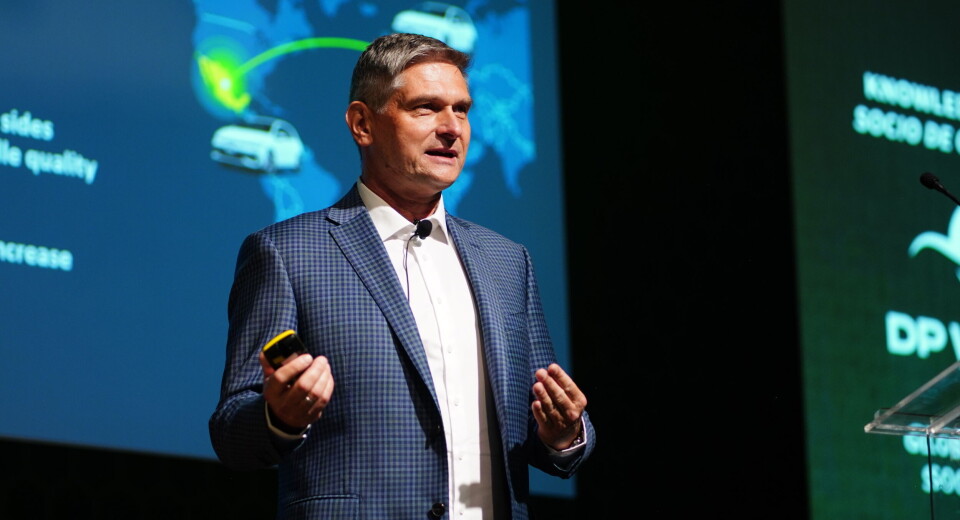
Volkswagen de México's Peter Koltai shared with attendees at ALSC Mexico 2026 the OEM's approach to "moving at Mexico speed"ALSC Mexico 2026
Peter Koltai, senior director of production control, logistics at Volkswagen de México, said that in order to execute this mammoth task, the local team had been given greater autonomy to develop solutions suited to the Mexican market, drawing on the experience and capabilities of local partners rather than relying solely on approaches developed at headquarters. “We have received a high level of autonomy for our own decisions here in Mexico,” he said.
The transfer will also significantly increase logistics requirements. Volkswagen expects a 320% rise in containers per week, while 86% of Golf production will be exported to Europe. To manage the additional volumes, the automaker is using external warehousing to provide storage capacity, alongside the ports of Veracruz and Tuxpan and dedicated Ferromex rail services.
Koltai said that although rail is not necessarily the quickest way to move product, the value of these dedicated trains was not simply speed, but predictability. “A dedicated train has an exact date of start and has an exact date of arrival,” he explained.
For Koltai, this is what moving at “Mexico speed” means: not simply doing things faster, but being able to respond quickly while maintaining reliability. That depends on local teams having the authority to make decisions, and on logistics partners being able to adapt alongside the OEM. As he put it, the aim is to be “fast, reliable, and ready”.
Viewing logistics providers as strategic partners
Addressing the room packed with industry decision-makers, Nissan's León highlighted a shared duty to move Mexico faster than other countries while also collaborating with all those countries. But to achieve that, he stressed the importance of building relationships with partners that extend beyond individual projects.
"We need to innovate, to see things in a different way, to create those relationships with our partners that can actually last longer than one or two years," he said, noting that closer partnerships allow for quicker decision-making processes, which ultimately will be necessary for Mexico's automotive industry to compete with the likes of China.
GM's Garcia also emphasised the need to involve suppliers and logistics partners earlier in planning, with OEMs working more closely with them to redesign networks, remove waste and improve competitiveness. “We need to engage early suppliers into the decisions, and we need to work together as OEMs, suppliers, and logistics partners,” she said.
León and Garcia were joined on stage by experts from Hellmann Worldwide Logistics and CSI Group, who shared the logistics provider's perspective on the matter. Alexandra Olvera, chief commercial officer at Hellmann Worldwide Logistics, argued that logistics providers need to be involved from the outset of projects, rather than brought in once decisions have already been made.
Speakers highlighted the need for close collaboration between OEMs, suppliers and logistics partners during ALSC Mexico 2026's Mexico in motion panel discussionALSC Mexico 2026
“Logistics providers need to be involved from the beginning, and be part of the setup and the conception of the project,” she said, stressing that their role should extend beyond transportation to the initial design and planning of supply chains. She also highlighted the importance of making this collaboration part of everyday operations, rather than limiting it to individual projects, so that providers can contribute to network redesign and make better use of shared information.
Meanwhile, Antonio Zepeda Torres, chief commercial director at CSI Group, pointed to the benefits of aligning the contract periods of different logistics providers, giving them a more consistent view of the supply chain and a longer-term basis for planning. Rather than having separate providers working to contracts of different lengths, he said, some customers have found success in aligning them around a common five-year period.
This, he noted, allows providers to receive “the same information and the same scope” while building familiarity with one another's operations. That coordination becomes particularly valuable during new model launches, when higher volumes need to be handled in shorter periods, enabling providers to respond more effectively to operational challenges.