OEMs adapt to shifting growth and EV trends in ASEAN
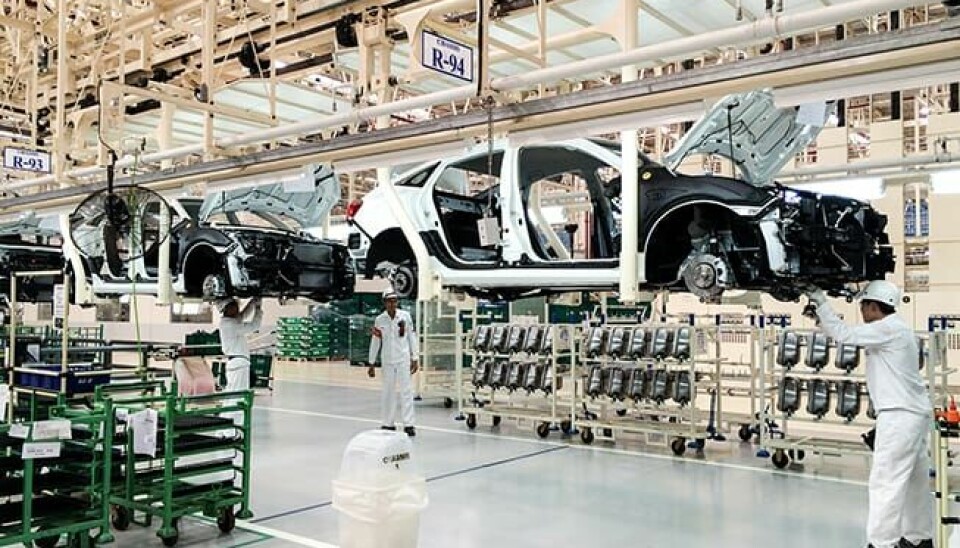
Honda Automobile Thailand
SMMT
OEMs and logistics providers in ASEAN are navigating diverging market recoveries, rising EV adoption, and structural shifts in supply chain flows as Chinese OEMs expand, localisation accelerates, and new infrastructure demands emerge.
The ASEAN automotive market experienced a downturn in 2024
but is set for modest recovery this year. However, the region’s six core
markets of Malaysia, Indonesia, Thailand, Vietnam, Philippines and Singapore show
increasingly divergent trends, driven by uneven demand, accelerating EV
adoption and shifting OEM strategies. These developments are reshaping vehicle
flows and supply chain logistics across the region.
According to PwC’s latest market outlook, light vehicle
sales across the ASEAN-6 declined by 5.4% in 2024, to 3.28m units. Thailand and
Indonesia were hardest hit, with volumes falling 25% and 13% respectively,
largely due to economic headwinds and tighter access to auto loans. In
contrast, Malaysia, Vietnam and the Philippines saw vehicle sales rise,
supported by economic growth, new product launches and stronger consumer
sentiment.
PwC forecasts that total volumes will rebound by around 2%
in 2025, led by gains in Malaysia and the Philippines, though Indonesia and
Thailand remain downside risks.
Chinese OEMs gain ground, led by EVs
One of the most disruptive trends is the rapid ascent of
Chinese carmakers, who are gaining share across ASEAN, particularly in the
fast-growing EV segment. Their affordable models are competitive and
intensifying competition with Japanese OEMs that have long dominated the
region.
EV penetration across ASEAN-6 grew from 9% in 2023 to 13% in
2024, with Thailand, Indonesia and Malaysia seeing the fastest uptake.
Government incentives, the rollout of charging infrastructure and increased
consumer interest in sustainability are further accelerating the transition.
Thailand and Indonesia are emerging as regional EV
manufacturing hubs. Malaysia is also targeting EVs to comprise 20% of the fleet
by 2030, rising to 80% by 2050, supported by a combination of import duties,
excise tax exemptions and local manufacturing policies.
OEM localisation and cross-border flows
As EV volumes rise, OEMs are adapting their supply chain
footprints and logistics models. Chinese brands are localising manufacturing in
Indonesia, Thailand and increasingly in Vietnam, establishing EV component and
battery plants to serve regional demand. Japanese OEMs are countering by
consolidating operations in more resilient markets such as Malaysia and the
Philippines.
These shifts are driving new flows of inbound components and
outbound vehicle shipments. Cross-border trade within ASEAN is increasing,
particularly in CKD (complete knock-down) kits and parts moving between
Thailand, Indonesia, Vietnam and the Philippines. Logistics providers are
playing a greater role in managing these distributed networks, balancing
capacity amid uneven demand and fragmented customs procedures.
Infrastructure and digitalisation under strain
The changes in production and distribution are adding
pressure to regional logistics infrastructure. Rising vehicle flows and
EV-specific needs are challenging port capacity, customs clearance processes,
and inland transport networks.
Governments and private sector stakeholders are investing in
EV-ready logistics infrastructure, including port electrification, warehousing
upgrades, and dedicated zones for battery handling and recycling. At the same
time, logistics providers are under pressure to accelerate digital
capabilities, including track-and-trace, real-time visibility and emissions
accounting.
OEMs are also exploring more integrated digital systems to
manage supply variability and improve cross-border transparency, especially as
they add new suppliers and assembly operations across ASEAN.
Rebalancing supply chains in an uncertain recovery
The market recovery forecast for 2025 is modest and uneven.
Logistics strategies must adapt to lower volumes in Thailand and Indonesia,
while scaling operations in growth markets such as Vietnam, Malaysia and the
Philippines. The evolving mix of EVs, hybrids and ICE vehicles also increases
complexity in multimodal transport, warehousing and parts distribution.
The region’s supply chain resilience will depend on flexible
network design, deeper collaboration between OEMs and logistics partners, and
the ability to integrate new entrants, particularly Chinese EV brands, into
existing logistics ecosystems.
While ASEAN’s total vehicle sales may remain below
pre-pandemic highs for some time, its role as a competitive production base and
emerging EV export hub will only grow. For logistics leaders, now is the time
to future-proof networks and invest in infrastructure that can adapt to a
rapidly changing automotive landscape.
Automotive Logistics will explore the ASEAN market more in our upcoming event, Automotive Logistics & Supply Chain ASEAN, in Singapore on 28th October.
The event will include expert insights from the likes of VW Group Malaysia, Denso China, Stellantis India and Asia Pacific and more! There's still time to register here to secure your place.