Škoda produced more than one million vehicles in 2025 following opening of new plant in Vietnam
In 2025, 1,065,000 Škoda vehicles were produced worldwide, representing a year-on-year increase of 15%. This followed the opening of a new production plant in Vietnam on 26 March with regional partner and investor Thanh Cong Group.
More than one million Škoda vehicles were produced worldwide in 2025Škoda
Figure 1: Škoda vehicles manufactured worldwide (2019-2025)
Year
Vehicles produced
2019
1,243,222
2020
941,131
2021
802,266
2022
764,994
2023
888,418
2024
925,164
2025
1,065,000
This marks the first year in which the brand has surpassed the milestone of more than one million vehicles produced since before the Covid-19 pandemic (see Figure 1). This increase in output can be attributed to improved production operations at Škoda's domestic plants in the Czech Republic, as well as investment in international plants including the opening of a new production facility in Vietnam.
Central to Škoda's strategy that has allowed it to achieve this milestone have been: flexible manufacturing lines; high output of components; a geographically dispersed completely knocked-down (CKD) and semi-knocked-down (SKD) assembly footprint; and integrated supply chain and logistics operations.
"The expansion of our production capacities in 2024 has paid off in full over the past year," said Andreas Dick, Škoda Auto board member for production and logistics. "For the first time in six years, we have exceeded the milestone of one million Škoda vehicles produced. This is a tremendous achievement and a testament to the team spirit of our production crew, who work hard to meet the demand for our models."
Czech production
Advertisement
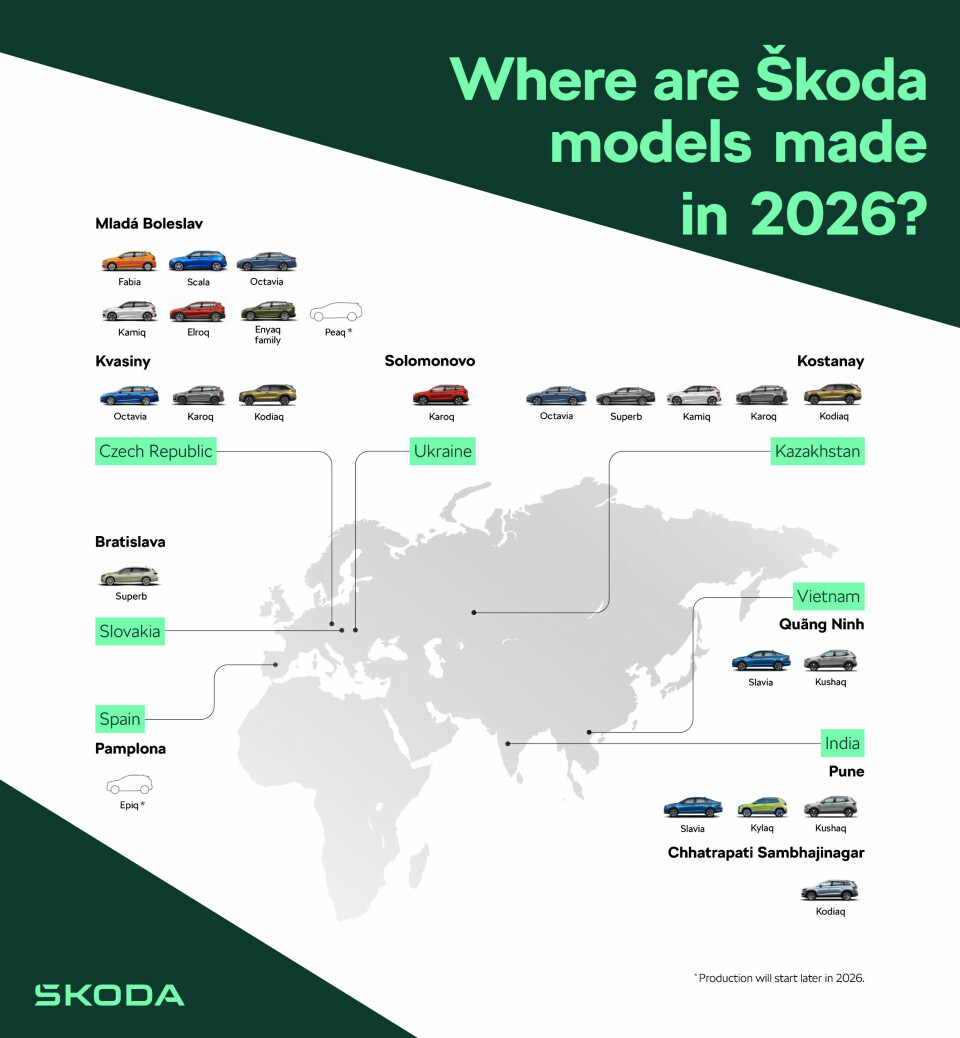
Škoda has two vehicle production plants in the Czech republic: one in Mladá Boleslav and one in Kvasiny. At the Mladá Boleslav plant, 605,600 Škoda vehicles were produced in 2025 – a 4.9% increase on 2024.
By the end of 2026, Škoda is set to produce vehicles in seven different countries around the worldŠkoda
Vehicles produced at the site included the Fabia, Scala, Octavia and Kamiq model lines, as well as the all-electric Enyaq, Enyaq Coupé and Elroq.
What's unique about this plant is ICE vehicles on the Volkswagen Group MQB platform and EVs on the MEB platform can be produced side-by-side on the same production line, making Škoda's Mladá Boleslav facility the only plant in the Volkswagen Group capable of this.
According to Škoda, this increases manufacturing flexibility and enables rapid adaptation to changing customer demand.
In Kvasiny, 301,500 Škoda vehicles were manufactured in 2025, marking a 21.6% year-on-year increase. Models assembled here were the Octavia, Karoq and Kodiaq.
In response to high demand for the Kodiaq SUV, production of this model was expanded to a second line.
European production
In Bratislava, Slovakia, where the Škoda Superb is assembled alongside the Volkswagen Passat, 69,500 vehicles were produced in 2025, up 27.5% on the previous year. In Ukraine, 1,200 Karoq SUVs were produced in Solomonovo from SKD kits (no vehicle production data is available for 2024, but 2,580 vehicles were assembled there in 2023).
Advertisement
International production
In 2025, Škoda increased its manufacturing footprint in Asia, opening a new production plant in Vietnam in March with regional partner and investor Thanh Cong Group. Škoda described the opening of the plant in Vietnam as "a significant milestone in the brand’s internationalisation strategy" which it said reinforces its ambition to strengthen its presence beyond its home market of Europe.
"The start of production at the new plant in Vietnam, in cooperation with our partner Thanh Cong Group, contributes to leveraging synergies in Southeast Asia," commented Dick.
Production of the Slavia and Kushaq models began in 2025 at a new plant, with 2,500 vehicles produced there by the end of the year.
In India, Škoda vehicle production more than doubled from 32,800 in 2024 to 73,800 in 2025, with more than 85,000 Volkswagen Group vehicles produced alongside the Škoda cars last year.
The local logistics centre prepares Slavia and Kushaq models as CKD kits, which are assembled at the newly opened plant in Vietnam. At the Pune plant, the Slavia, Kushaq and Kylaq models are produced, while the Kodiaq SUV is built on the line at the Chhatrapati Sambhajinagar facility.
Škoda has said it is leveraging synergies with its plants in Vietnam and India to unlock the potential of the ASEAN region and the Middle East.
"In India, our new, locally manufactured Kylaq SUV has got off to a very successful start, thanks in large part to the tremendous efforts of our colleagues there," Dick added.
Advertisement
Elsewhere in Asia, Škoda's vehicle output in China dropped from 15,200 units in 2024 to 12,100 in 2025 – a 20.4% year-on-year decrease. This comes after Volkswagen Group and partner SAIC confirmed the closure of their joint plant in Nanjing, China. Production was halted at the plant in July, set for a gradual closure throughout 2025.
As well as the Nanjing plant, Škoda also produced vehicles in the Chinese cities of in Changsha and Ningbo in 2025. Last year, the carmaker produced the Octavia, Kamiq, Kamiq GT, Karoq, Kodiaq, Kodiaq GT and Superb models in China, but it has not listed any Chinese plants in its infographic outlining where Škoda models will be produced in 2026.
Additionally, Škoda assembled 2,800 vehicles from SKD kits in Kostanay, Kazakhstan in 2025, including the Octavia, Superb, Karoq and Kodiaq models. This is double the output from Kazakhstan in 2024.
Beyond finished vehicles, Škoda also saw significant output of vehicle components in 2025. It built more than 329,000 battery systems for Škoda electric and plug-in hybrid vehicles, as well as for other Volkswagen Group models, at its Mladá Boleslav facility. Here, a further 513,800 EA 211 petrol engines and 311,300 MQ 200 manual transmissions – which are also supplied for use in other Volkswagen Group vehicles – were also produced.
Its Vrchlabí plant also produced a total of 721,400 DQ 200 seven-speed DSG transmissions, more than half of which were used in models of other Volkwagen Group brands, taking its total transmission output in 2025 to more than one million. In February, the Vrchlabí plant produced its six-millionth transmission since production began in 2012.
By using Škoda's Czech facilities not just as vehicle manufacturing plants, but also as powertrain and battery hubs, Volkswagen Group can operate high-volume, structured inter-plant logistics corridors while maintaining multi-powertrain flexibility – a critical advantage given policy and market uncertainty surrounding electrification today.