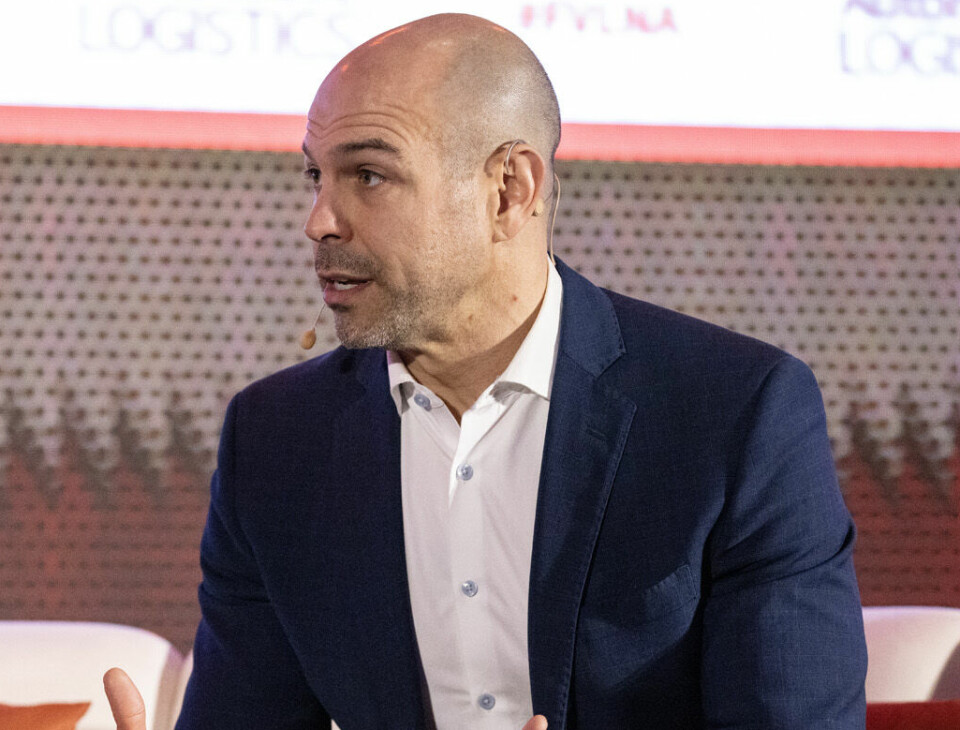
“Survive and advance,” Anu Goel said, as he shares how Volkswagen Group of America is turning turbulence into a logistics mandate
Speaking at the Finished Vehicle Logistics North America 2026 conference on April 22, Volkswagen Group of America’s Anu Goel – later joined by fellow panellists from Wallenius Wilhelmsen and Blue Yonder – said today’s finished vehicle logistics leaders must build networks that can adapt at speed, as tariffs, geopolitics and capacity shocks turn resilience into a business imperative.
Anu Goel, executive vice-president of group service and after-sales, Volkswagen Group of AmericaSource: Automotive Logistics
There’s a phrase Volkswagen Group of America's Anu Goel
likes to use when describing the operational environment of the past two years.
“WTF,” he explains to attendees at the Finished Vehicle
Logistics North America 2026 conference in California, is “Why The Face?” –
a nod to Modern Family’s Phil Dunphy, for those who follow the show. But behind
the humour sits a question: how do you build an organisation – and a logistics
network – that can absorb whatever comes next?
That question has been among the many challenges Goel has faced in his role as executive vice-president of group service and after sales at Volkswagen Group of America, and it also emerged
as a common thread throughout the conference. From ships doing circles in the
Atlantic to vehicles backlogged in Mexico, Goel laid out an account of where
VW’s North American finished vehicle logistics network has been, what it has
been through, and where the “survive and advance” imperative is now pointing.
Speaking again this year having delivered
a keynote at FVL North America 2025, Goel returned acknowledging that the
disruptions his organisation has faced since Covid have not eased, but have
continued to build.
Key session takeaways
The operating mandate is “survive and advance”. Companies
must cut costs where necessary, but not at the expense of the network
capability required to capture recovery when it comes.
AI and automation will only be as strong as the
data behind them. Without harmonised metrics, common definitions, and supplier visibility – down to steel and aluminium content at part level –
results can fall short.
The smartest response to volatility is
intentional flexibility. That means carriers, OEMs and technology partners
prioritising network optionality, end-to-end integration, and disciplined
execution instead of duplicating capacity.
Scenario planning is a core business competency. Companies
that build decision frameworks in advance – and act quickly – will hold a clear
competitive edge.
People resilience is as important as network
resilience. Building resilience also means investing in cross-skilling,
ensuring managers can use predictive tools effectively, and transferring
critical expertise from retiring employees to the next generation.
Building the regional foundation
Advertisement
Goel’s starting point was structural. Prior to Covid,
Volkswagen Group brands – VW, Audi, Porsche, Bentley, Lamborghini, Bugatti –
each planned their logistics networks individually, by country. The result, as
he described it, was a recipe for silos, duplicated cost and compromised
service.
In response, the company created a North American Region
(NAR) finished vehicle logistics organisation, bringing the US, Canada and
Mexico together under a single planning framework while working to better align
the region’s multiple brands. Reflecting on the rationale, Goel said that once
the regional picture was clearly laid out, there was strong support for a more
joined-up approach.
The impact of the new structure was tangible. A backlog of
more than 50,000 vehicles in Mexico was cleared, wholesale volumes increased
and inventory levels were reduced. “We make the structure change, you start
making decisions on what’s best for the region, and performance improves,” said
Goel.
He also noted that the transition was far from simple. Legal
constraints meant direct reporting lines between Mexico and the US were difficult, while bringing several brands into a centralised model for finished
vehicle wholesale operations required significant internal alignment.
“You
have to get your organisations and your networks set up to handle whatever
comes at you. Is your network able to handle uncertainty? What's the amount of
time it takes you to adapt?” – Anu Goel, executive vice-president group service
and after sales, Volkswagen Group of America
WTF moments: From bridge collapses to circling ships
With the structural foundation described, Goel moved through
a catalogue of disruptions – “WTF moments” – that the network has had to
absorb. Software holds, quality stops and the Francis Scott Key Bridge collapse
all featured. But he emphasised concern around the tariff volatility and its operational
consequences.
When the Trump administration’s Liberation Day tariffs came
into effect on April 2, Volkswagen Group of America faced the same immediate
challenge as other importers: tariff rates are applied when a vessel unloads,
not when cargo clears customs. With rates uncertain and subject to change, the
company chose in some cases to keep vessels offshore rather than bring them
into port.
Goel said the move created wider disruption across the
network, as delayed arrivals led to missed unloading windows and added pressure
across already busy port operations.
He also pointed to the wider financial impact of tariffs on
the automotive sector, noting that import-reliant brands can face a
particularly heavy burden. For Volkswagen Group, this is especially significant
for Audi, whose vehicles for the US market are sourced from overseas.
Tariffs have also created complexity in aftersales
operations. Volkswagen manages around 410,000 service part numbers across the
US for the VW and Audi brands, and calculating duties on components containing
steel and aluminium has become increasingly difficult because detailed
material-content data is not always available throughout the supply chain. As a
result, some parts may attract tariffs based on their full declared value
rather than only the relevant material content.
Separate geopolitical disruption has added further pressure.
Volkswagen builds its Atlas family of vehicles in Chattanooga, Tennessee – and
exports some of that production to the Middle East. Ongoing
instability in the Strait of Hormuz has affected shipping routes, leaving
some export units held at Brunswick and Jacksonville and adding to inventory
pressure.
Goel said the situation has prompted closer coordination
between logistics, production and sales teams, including discussions around
adjusting output for affected markets. His broader message was that logistics
teams need earlier involvement in commercial and production decisions so risks
can be managed proactively rather than after disruption has already occurred.
AI, data and the limits of the black box
Much of the conference’s wider discussion touched on AI
and data-led decision-making. In Goel’s view, the value of AI depends entirely
on the quality of the data behind it, and in many areas that foundation still
needs work.
For Goel, the opportunity in AI is less about automation
for its own sake and more about enabling better decision-making through
stronger visibility and more accurate information. “It’s about AI getting [the
right] information so we can make better decisions. That’s where I’m focused
now,” Goel said.
Advertisement
He cited tariffs as a practical example. If Volkswagen
could access precise steel and aluminium content data for every component in
its supply chain, it would be better placed to apply the correct duty rates
rather than using more conservative estimates. However, obtaining that level of
transparency across multiple supplier tiers remains difficult, particularly
where commercially sensitive cost information is involved.
“Survive and advance”: Partnerships, flexibility, and the
next phase
Framed against the NCAA basketball tournament – in which
Goel’s alma mater had recently competed – he described Volkswagen’s current
operating approach as one of “survive and advance”. The pressures facing the
business are immediate: with logistics representing around 40% of the company’s
total cost base, every decision is under scrutiny. But, he warned, the greater
risk is cutting too deeply in the short term and weakening the capability
needed when demand returns.
That framing led to his focus around partnerships. Volkswagen
has contracted ships that, after delivering imported vehicles, often return to
Europe with limited backhaul loads. Goel said the company is now examining
whether those return sailings could carry vehicles for other manufacturers to
help offset costs. Discussions, he noted, have already moved into practical
implementation.
He also outlined a broader opportunity to widen the remit of
finished vehicle logistics across the North American business. By bringing
additional Volkswagen Group brands into scope, alongside container management
and inbound logistics, the scale of spend and volume managed through a combined
structure could increase significantly.
Asked by an audience member whether Volkswagen Group of
America was considering an internal 4PL model to coordinate these synergies and
improve cross-brand collaboration, Goel indicated that a range of structural
options are being assessed, including a dedicated internal entity.
Throughout the session, Goel repeatedly returned to
leadership culture as a critical enabler of performance – maintaining calm
under pressure, encouraging transparency so issues are surfaced early, and
being willing to act decisively in the short term to avoid greater cost later.
Resilience in motion: The next phase of vehicle logistics
Immediately following his keynote, Goel joined a panel
discussion alongside Michael Rye, senior vice-president customer growth Americas
at Wallenius Wilhelmsen, and Shay Sidnerl,
automotive industry expert at Blue Yonder.
The session built directly on the themes raised in Goel’s address, as the
panellists explored what resilience means in practice – and how organisations
can strengthen it while operating under intense cost pressure.
Rye opened with a distinction that shaped much of the
discussion. Resilience, he argued, should not be confused with redundancy.
Redundancy can add cost without improving adaptability. The real objective, he
said, is “intentional flexibility” – creating optionality across ports,
terminals, vehicle processing centres and transport hubs, supported by
end-to-end data integration and the operational discipline to execute
consistently.
Rye said the focus should be on building networks with
multiple options available, enabling disruption to be contained rather than
amplified when conditions change.
He also addressed volatility across global trade lanes.
Concentrated disruption around China, he noted, was reshaping flows by
constraining some routes while creating opportunities elsewhere, including in
emerging South American markets. The challenge for logistics providers is
maintaining reliability and cost transparency for customers during periods of
pricing volatility, particularly when geopolitical events such as disruption in
the Strait of Hormuz affect shipping markets.
On long-term capacity planning, Rye said that short-term
uncertainty cannot be allowed to delay strategic investment. He said decisions
on vessel capacity must be taken with a 20- to 30-year horizon in mind, warning
that failing to invest now would only defer future constraints. He added that Wallenius Wilhelmsen has already committed $1.6
billion to 14 new vessel builds scheduled to enter service in 2026 alone.
Shay Sidnerl, automotive industry expert, Blue YonderSource: Automotive Logistics
Making the data work
Sidnerl focused on the foundations of better decision-making,
ensuring that the vast amount of data generated across vehicle logistics is
turned into timely, practical insight. She explained that Blue Yonder’s
approach centres on a single platform that connects data from across the
enterprise and wider partner networks, using AI to support faster and more
coordinated planning decisions rather than isolated functional responses.
She highlighted a persistent challenge in the automotive
sector, where manufacturing and finished vehicle logistics teams often work
from separate data streams. The result can be decisions in one area that do not
fully reflect the operational impact on the other. Sidnerl said the opportunity
lies in linking those flows more effectively – using production data earlier to
prepare yard capacity, group vehicles more efficiently, reduce dwell time and
prioritise customer orders sooner in the process.
She also stressed the importance of scenario planning. In an
environment where disruption signals often emerge gradually, organisations need
the ability to model potential outcomes in advance and understand what actions
they would take before events fully materialise.
People resilience
The panel’s closing exchanges turned to the resilience of
the people behind the operation. Goel spoke about his approach to leadership
under pressure, emphasising the importance of sharing context and
decision-making rationale with teams rather than insulating them from
challenges, and creating the space for them to develop solutions of their own.
He said one of the most valuable lessons in his career came from a former
manager who encouraged him to trust his team’s capabilities more fully.
Rye continued the theme, noting that while cross-skilling
operational teams remains an ongoing focus at Wallenius Wilhelmsen, an equally
important challenge is ensuring managers and leaders are equipped to use
predictive data tools effectively. Without that capability, he suggested, even
the best systems cannot deliver their full value.
Sidnerl added that the retirement of experienced employees
presents a growing risk to organisational knowledge. Ensuring that expertise is
transferred to the next generation – and captured in ways that can strengthen
digital and AI-enabled tools – should be viewed as a strategic priority rather
than solely a people function.
The panel ended, fittingly, noting that “resilient people”
were as much a component of resilience in motion as any technology platform or
network design – and that the industry’s ability to navigate what comes next
will depend at least as much on its leaders and workforce as on its
infrastructure.