Inbound logistics at the crossroad of cost, resilience and digital change
As cost pressure, trade turbulence and electrification collide in 2025, automotive supply chain leaders are putting inbound logistics at the centre of strategy – accelerating digitalisation, resilience and collaboration to protect performance and value.
Automotive inbound logistics has always been complex, but in 2025 that
complexity was tested on multiple fronts.
Cost pressure has returned sharply to the top of the agenda for inbound teams,
driven by volatile trade policies, new tariffs, geopolitical tensions and an uneven,
often unpredictable transition from internal combustion engines to electric
vehicles.
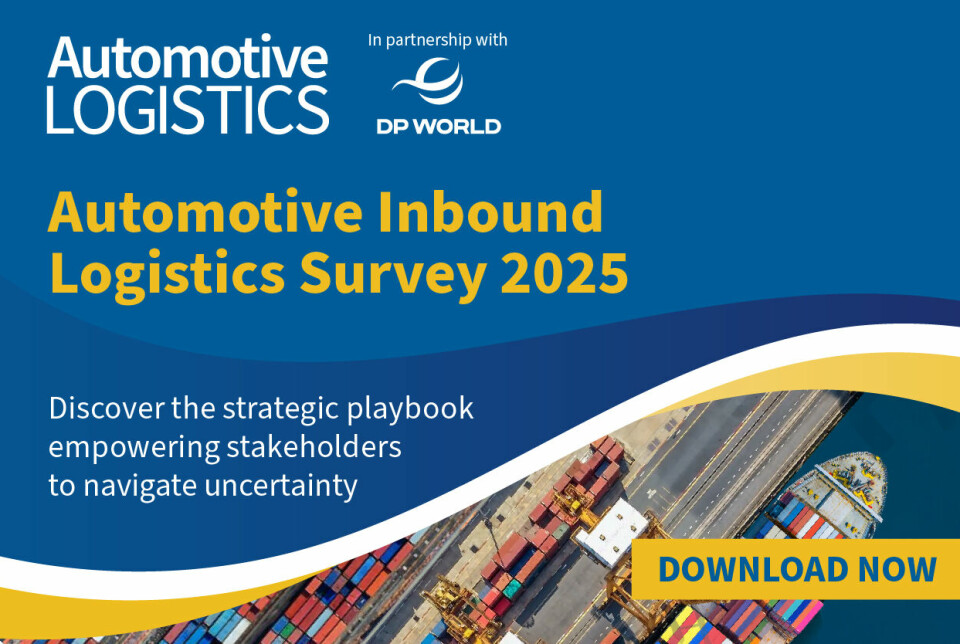
Those pressures sit at the heart of the Automotive Inbound Logistics
Survey 2025, produced by Automotive Logistics in partnership with DP
World, and explored further in the accompanying video recorded at the 25th
Automotive Logistics & Supply Chain Global conference. In conversation, DP
World’s global vice-president and automotive vertical lead David D’Annunzio,
and Automotive Logistics analyst Daniel Harrison reflect on how OEMs,
suppliers and LSPs are adapting as established sourcing and planning models
come under strain. The video expands on the survey’s findings with practical
context from the conference floor, linking data with real-world decision-making
in inbound logistics.
What emerges is a clearer picture of inbound logistics as a determining
factor in wider supply chain performance. Decisions taken upstream – around
network design, capacity, data and collaboration – are increasingly shaping
production stability and downstream service. Cost remains the dominant
constraint, but inbound logistics teams are under growing pressure to plan for
disruption and flexibility alongside cost control as part of wider supply chain
and production strategy.
Cost and trade turbulence reshape strategies
Cost considerations are dominating
decision-making in inbound logistics. In the survey (a global study
of OEMs, tier suppliers and LSPs), 41% of industry respondents flagged rising
costs – from inflation to labour and energy – as a primary concern, while 37%
pointed to trade wars, tariffs and shifting policy as a source of ongoing
uncertainty.
Tariff uncertainty, in particular, is reinforcing a cautious
“wait-and-see” stance. Many companies are deferring major investment or
localisation decisions, instead relying on short-term measures such as
multi-sourcing, rebalancing production between plants and temporary capacity
adjustments. As Harrison notes in the video, these responses reflect pragmatism
rather than confidence – maintaining continuity while delaying irreversible
decisions.
Carmakers
are also contending with powertrain transition pains – juggling internal
combustion and EV production – which
“increas[es] the complexity of assembly,” as D’Annunzio notes – to an
already cost-sensitive inbound network.
Resilience becomes
an operational requirement
While cost remains the overriding concern, inbound
logistics strategies are increasingly being shaped by the need to absorb
disruption, manage risk and maintain flexibility. Survey respondents ranked resilience
among their top three priorities, driving investment in buffer stock,
alternative routing options and supplier diversification, alongside closer collaboration
up and down the supply chain. Indeed, nearly one-third of executives surveyed
cited deeper partnerships and data sharing with logistics providers as key to
coping with uncertainty.
The consensus at recent Automotive Logistics industry
forums too confirmed that the
path forward lies not in resisting unpredictability, but in embracing it – replacing
rigid plans with flexible frameworks, real-time data visibility and trust-based
collaboration.
“We
are all grappling with [constant change]... the best you can do today is have
flexibility, or ‘optionality’ in your supply chain,” says D’Annunzio,
emphasising that having multiple fallback options may sometimes trump choosing
the lowest-cost route when disruption hits.
Digitalisation and long-term value
Despite short-term pressure, the medium- to long-term outlook for
inbound logistics remains broadly positive. Survey respondents point to
accelerating digitalisation as a key enabler, with investment flowing into advanced
planning tools, predictive modelling and selective applications of AI to
simulate “what-if” scenarios and optimise inbound flows.
Crucially, digitalisation is reinforcing collaboration. Shared data and
connected systems are improving end-to-end visibility, enabling OEMs, suppliers
and logistics providers to manage disruption more proactively. As DP World’s
chief operating officer for logistics Beat Simon notes in the survey foreword: “To
succeed, we must accelerate digitalisation, strengthen planning, and build
data-sharing partnerships that enhance visibility and resilience across
automotive supply chains.”
Taken together, the survey findings, video insight and wider Automotive
Logistics coverage point to inbound logistics playing a more direct role in
enabling production stability, flexibility and long-term performance. These
themes will continue to shape Automotive Logistics’ reporting, analysis
and events as inbound logistics remains central to how the industry navigates
uncertainty through 2026 and beyond.
More inbound logistics insight from Automotive Logistics