Trade uncertainty keeps North American production and logistics networks on alertAdobe Firefly | AI-generated image
A Democratic majority will struggle to reverse Trump's tariffs and fuel policies, but greater congressional scrutiny could influence automaker investment, production decisions and North American supply chain planning.
At a glace
Democrats won both chambers of Congress in the 3 November midterms, but a presidential veto limits how far they can reshape US auto policy.
Section 232 tariffs rest on presidential authority, so Democratic levers are oversight, the USMCA review and trade-talk pressure rather than repeal.
Reviving the $7,500 EV credit, restoring tougher fuel economy rules or collecting CAFE fines would need Republican votes to survive a veto.
Democrats now control Michigan's governorship and legislature and won Texas's governorship, so state rules on EVs and infrastructure may shift faster than federal ones.
Democrats now hold both chambers of Congress, but a Democratic majority is not a Democratic policy. After the midterms on 3 November, the party stands to control the House and the Senate, with at least 54 Senate seats and a House majority above 250 seats, the party's largest since 2008.
Wide reportage points to 89% of voters calling the cost of living a major or crucial factor, while President Donald Trump's approval rating stands at around a mere 38%. For vehicle manufacturers the harder question is what a new majority can change inside the plant gates, and how quickly.
Why the veto matters more than the majority
Trump has already signalled that he will use the pen. After the results he posted an image of a red hat bearing a single word, "VETO". However, overriding a veto needs two-thirds of both chambers, and a Republican-led Congress was unable to reach that threshold after two vetoes earlier in this term.
Advertisement
At 54 Senate seats Democrats are well short of the 67 they would need on their own. (Two Senate contests - Alaska and Mississippi - remain uncalled as of 9 November 2026. Even if Democrats win both remaining races, their maximum total would reach 56 seats, still 11 votes short of a two-thirds supermajority.)
And the tariffs that matter most to plants also stand on firm legal ground. Section 232 duties of 25% on imported vehicles and most parts rest on a national security finding, and Korea's 15% rate was set without a vote in Congress, as Korea’s Kyunghyang Shinmun has noted.
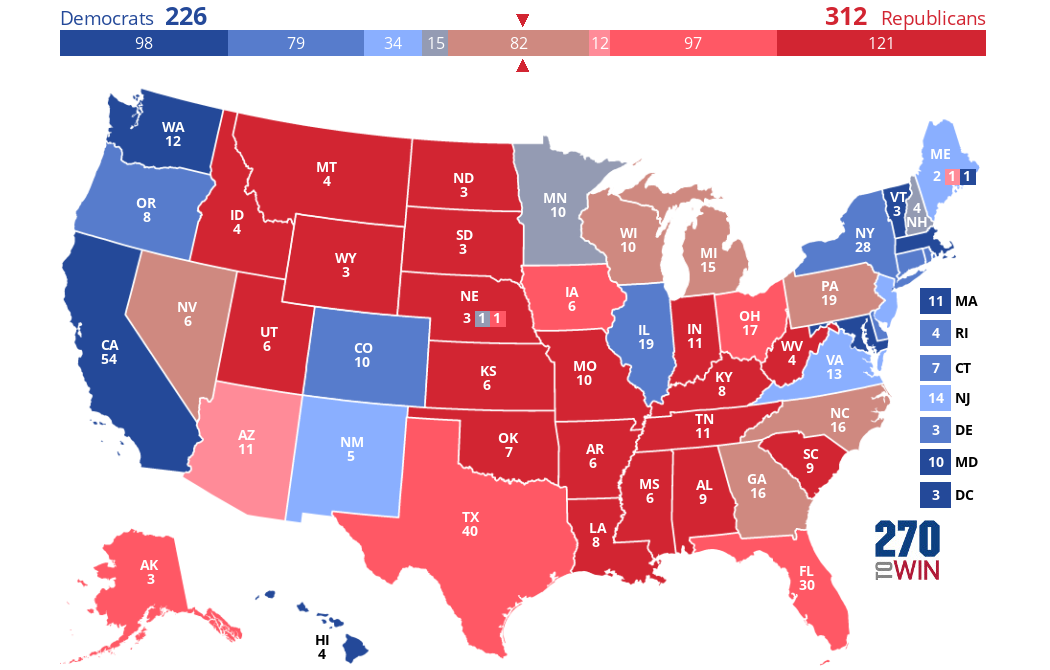
Source: 270toWin
Parts that meet USMCA rules of origin are exempt from the parts duty. The Supreme Court did rule the emergency-powers tariffs unlawful in February, and the Treasury had refunded $49.2bn by June as reported by Automotive Logistics, but Section 232 rests on a separate statute and remains in place.
Washington declined on 1 July to renew the agreement in its current form, which triggers annual reviews rather than termination, and Congress has a consultative role in that process. Cox Automotive analyst Erin Keating told Autoblog that "Automakers want something solid and stable, something they can plan against." Democrats are expected to press the White House to finish the talks, because drawn-out uncertainty makes long-range investment hard to sign off.
Oversight is the real power
Congress holds subtler tools than repeal, and for a plant manager they may prove more consequential. The law firm Yulchon told clients that a Democratic-led Congress could demand data on investment commitments and employment performance, or summon carmakers to explain them, according to the Kyunghyang Shinmun. That matters in a sector that has moved volume in anticipation of trade policy. GM's $4bn plan to shift assembly from Mexico and Canada is one example. Commitments made under tariff pressure may now be tested in public hearings.
Republicans' 2025 budget law ended federal clean-vehicle tax credits and cut penalties for missing fuel economy standards to zero, according to S&P Global. The finalised rule now asks carmakers for gains of up to 1% a year, which AMS reported would land the industry at about 34.9mpg by the 2031 model year, against 50.4mpg on the Biden-era path. Looser fuel rules leave factories with hard choices because a line tooled for one trajectory is not obviously useful on the other.
Advertisement
It’s possible that lawmakers could try to reinstate the credit of up to $7,500, push for a tougher mileage target and force the administration to collect the fines carmakers technically owe. Any such bill meets the veto arithmetic above. S&P Global's analysts add that multiyear product cycles limit how quickly any federal change alters what plants build.
Demand, however, has not waited in the meantime. Hybrid sales have set records, inflation reached 3.7% in September, petrol is up almost 50% since the Iran war began, and the average transaction price passed $52,000 in October, according to Cloud Theory, as cited by Autoblog.
Statehouses, China and the data centre backlash
Some of the quickest change may come outside Washington. Democrats won full control of Michigan's state government, with Jocelyn Benson elected governor and the state House flipped. They also won the Texas governorship and several statewide offices that had eluded the party for 32 years. Keating expects state action to reach EV mandates and charging infrastructure.
The election changed who asks the questions, it did not, however, change who writes the answers, and for the next two years plants will have to work with both
AMS
China is the one subject with bipartisan appetite; the Connected Vehicle Security Act, sponsored by Michigan's Democratic Senator Elissa Slotkin and Ohio's Republican Senator Bernie Moreno, would codify limits on Chinese connected-vehicle technology and, as drafted, would also bar Chinese carmakers from building and selling vehicles in the US.
Analysts expect it to be a low priority, partly because consumer surveys show interest in cheaper Chinese-brand models. Ford chief executive Jim Farley has described the arrival of such rivals as a threat to the carmaker's existence.
The newest variable in all of this is the data centre.Backlash over the environmental and community impact of new sites became a campaign issue, and some now fear Democrats could slow AI infrastructure spending. Energy Intelligence says the outcome may alter where such sites are built and how they are powered.
Ford's new energy business plans to build grid-scale storage at a repurposed Kentucky facility for utilities, data centres and industrial customers, targeting at least 20GWh a year by late 2027. Whether tighter scrutiny of data centres helps or hurts that demand remains yet unproven.
The sensible planning assumption is that rules will change slowly while questions arrive fast. Tariffs will persist on statutory ground, the USMCA reviews will recur every year, and fuel rules will keep their looser shape unless Republicans break with the White House. What shifts is who must justify a plant decision, and before whom.
The election changed who asks the questions, it did not, however, change who writes the answers, and for the next two years plants will have to work with both.