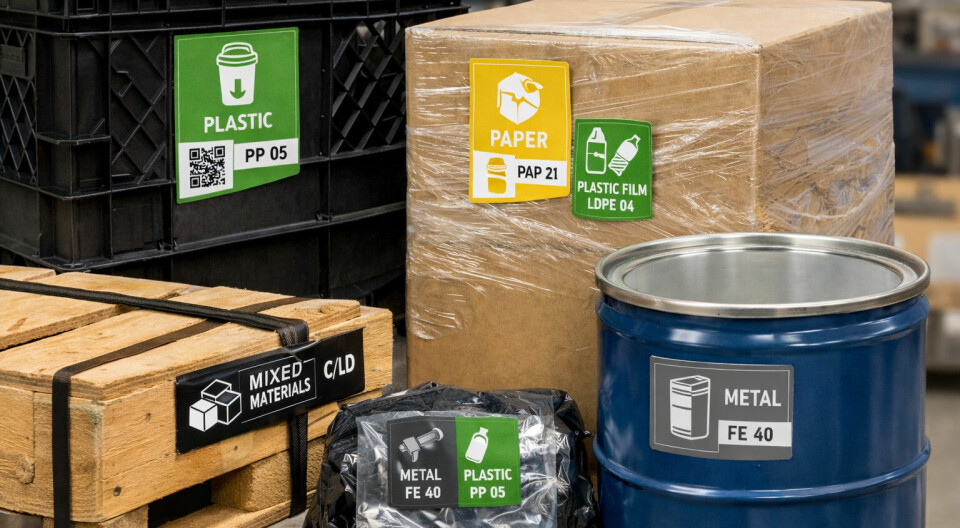
Since February 2025, the EU's Packaging and Packaging Waste Regulation (PPWR) has been in force, and from August 2026, the new obligations will apply. Those who approach the remaining transition phase half-heartedly may miss the mandatory start date. Unlike other sustainability regulations like the EUDR, there is no further grace period – the European Commission has made this clear.
Angelika MühleckAngelikaMühleckfor Leyton Germany
Boris Arno WerschbizkyBoris ArnoWerschbizkyfor Leyton Germany
PublishedModified
5 min
The PPWR requires an increase in recycled content; the impacts on material properties must be considered or compensated accordinglyAdobe Stock
This article originally appeared on the website of Automotive Logistics' sister title in Germany, Neue Verpackung
Across Europe, companies are examining their packaging, discussing material alternatives, optimising designs and processes. The focus is mainly on visible technical measures: material savings, mono-materials, recyclability. These activities shape self-assessment and convey the feeling of being on the right track. However, a reality check by Fraunhofer IML, Logistikbude and Initiative Mehrweg shows a different picture: the PPWR sentiment index 2025 reveals a discrepancy between perception and implementation capability.
Almost every second company overestimates its state of preparation. Only around 10% have created the structural foundations that are crucial for PPWR compliance: clearly defined responsibilities, a reliable data basis for packaging, a systematic portfolio analysis and documented measures. Too often, individual measures replace a holistic implementation – with a deceptive sense of security as a result.
A central paradigm shift of the PPWR is particularly underestimated: the complete transfer of the burden of proof and liability responsibility to producers and distributors. From August 2026, it will no longer be sufficient to technically optimise packaging or rely on supplier declarations. Companies must prove in a Declaration of Conformity (DOC) that each piece of packaging meets legal requirements – and that communicated environmental claims are reliable and verifiable. For the first time, packaging-related, audit-proof documentation is required, which must be kept up-to-date and presented to authorities or market partners upon request. This obligation applies to all sales, secondary and transport packaging within the EU, as well as imports. Responsibility cannot be delegated – it remains with the producer.
Advertisement
What are the consequences of non-conformity?
What happens if this evidence is missing or not reliable is still underestimated by many market participants. Non-conformity is not a theoretical risk. It will not be dismissed as a formal error, but can lead to delistings by trading partners, legal disputes over inadmissible green claims, reputational damage and direct loss of sales. Those who cannot provide evidence lose their ability to act.
Why data is both a challenge and a solution
For a DOC, information must be brought together that is currently distributed across departments, systems, and supply chains: material compositions, substance and additive information, recycling assessments. Dr David Strack, who is developing a solution for a declaration of conformity with greentech company Susy, described the gap as follows: "Many companies have relevant information – often just not in a form that can be compiled into a reliable DOC. At the same time, packaging portfolios are constantly changing due to new suppliers, adjusted formulations and design changes. Each adjustment can invalidate existing declarations of conformity."
As of today, only a few digital packaging management platforms solve this problem. Susy, for example, creates a central, consistent data basis, links AI-supported technical and regulatory information, and documents all changes. The system thus provides the continuously maintained proof as required by the PPWR from August and creates the basis for market access, legal certainty and credible sustainability communication.
Why the raw material is coming into focus
The requirements of the PPWR do not end with the finished packaging. They apply along the entire value chain – from material selection through formulation to later application. Especially where substances are developed, combined, or replaced, decisions are made that affect recyclability, functionality and proof.
An example is developments that make the use of recyclates more practical. High recyclate content often brings fluctuations in product properties in practice. To compensate for these, material solutions must already be addressed at the raw material and formulation level. Dr Ralf Moritz, managing director at Blend+, a supplier to the polymer industry, describes this approach as follows: "When material compositions change, it has direct effects on the later packaging. We are researching to stabilise properties so that products with recyclate content function comparably to those with virgin material. It is always crucial to trace the components used throughout the entire lifecycle."
Advertisement
This brings early material decisions more into focus from a regulatory perspective. What must later be considered in the conformity assessment does not arise only at the end of the chain, but begins with the selection and documentation of the starting materials.
Development work is becoming more important – and is often eligible for funding
The PPWR demands and simultaneously acts as an innovation catalyst. It forces market players to question existing material, formulation and process logics – a regulatory necessity that also leads to being at the forefront of competition. This development work binds time, personnel and budget, with an uncertain outcome. This is an effort that the German state encourages through the "research allowance" – through subsequent tax credits or in the form of payments. Up to 25% of eligible expenses are covered, and for small and medium-sized enterprises, up to 35%. Many PPWR-driven projects meet the criteria of the R&D allowance: there are technical risks, the outcome is open and solutions must first be developed.
The adjustments to material, formulation and process logics required by the PPWR can mean extensive development work, eligible for fundingHANNSES_BRAATZ
At Blend+, the development work did not begin with a funding commitment. The company consciously went ahead and only later sought professional support for the application for the research allowance: "We work with the funding advisor Leyton. I am convinced that this has significantly increased our chances of obtaining government funds."
Because the scientific consultants know how to structure development projects so that the research component is clearly recognisable to the examiners. In a 'technical report', they outlined the development goals for Blend+ and prepared all the documents for the application. "In 10 years of company history, none of us could formulate it as well as our consultant from Leyton,'" commented managing director Moritz. The research allowance was approved and today it acts not as a start-up, but as a risk buffer, which makes it possible to deepen development work instead of abandoning or postponing it for cost reasons.
Moritz described it very concretely: only through the promised funding can additional, expensive tests be realised, such as trials on industrial film systems, which quickly cost five-figure amounts and initially only deliver one thing: data. "These are tests that we simply could not afford without funding," said Moritz. The allowance thus creates financial leeway to secure development steps that are crucial for later industrial application.
Nine hacks for PPWR readiness by August 2026
Establish a realistic implementation plan with monthly milestones
Appoint a responsible person or core team for PPWR compliance
Identify and prioritise critical data gaps
Systematically involve suppliers and communicate data requirements
Evaluate and implement a digital packaging management system
Conduct compliance assessments for critical packaging
Prepare labelling requirements (QR codes, material labelling)
Conduct internal training on PPWR requirements
Apply for funding
The regulatory pressure arises indirectly. The PPWR, for example, does not directly affect Blend+, but affects customers – especially film manufacturers and converters. They face the challenge of processing high recycled content in the future without products becoming worse, more unstable or more expensive. This is exactly where the development work comes in: recyclates must work, properties must remain stable and processes must remain economical. Whether these solutions prevail on a large scale will only be decided in industrial use. However, development for this begins now – under the pressure of the PPWR and with the help of funding.
For companies, this can be crucial: while the EU regulation sets fixed deadlines, funding opens up financial leeway. It enables innovations to be implemented in a structured and planned manner, rather than being postponed.
Advertisement
Regulation with an economic agenda and a deadline
The PPWR is more than a set of rules for waste reduction. It is part of an industrial policy strategy with which the EU wants to establish the circular economy as an economic model: less dependence on primary raw materials, more value creation in Europe, more stable supply chains. The packaging industry is at the centre of this. Those who develop recyclable packaging, use recyclates functionally, master data and can prove compliance gain advantages. The PPWR rewards scalability, transparency and innovation capability.
Preparation therefore does not mean ticking off individual requirements, but building sustainable structures for data, development and decision-making ability along the entire value chain. This is exactly where the industry is currently separating. Time is now the decisive factor.
It is not crucial where a company stands today. What matters is that it starts now – systematically, structured and with a clear goal. Because the PPWR does not measure intentions. From August 12, 2026, it measures evidence.