Going green at scale demands more than ambition; it demands a different kind of partnership
Anushka DixitAnushkaDixitContent Manager
PublishedModified
5 min
The session's final conviction, shared across all three speakers, was that sustainability and competitiveness are not in opposition.
As leaders from JLR, Volvo Group and Wallenius Wilhelmsen made clear at ALSC Europe 2026, the gap between what is possible and what is deployed for low-emission logistics at scale is not primarily a technology problem. It is a collaboration, affordability and ecosystem problem and solving it will require the industry to work in ways it has never worked before.
Day two of ALSC Europe 2026 opened with a
sustainability morning, with keynotes from Levent Yuksel, freight operations director at JLR, and Jenny Westermark, senior vice president of logistics at Volvo Group, followed by a panel with Vedran
Muratbegovic, SVP of customer growth at Wallenius Wilhelmsen, to breakdown what has actually been achieved, where the gaps
remain, and what it will take to move from isolated pockets of progress to the
integrated, continent-wide green logistics networks the industry needs.
The honest picture
Yuksel opened the morning with a keynote that was direct about both wins and
failures. Across JLR's dedicated UK fleet, the company has converted to
alternative fuels - 150 HVO operations, 43 BioCNG and 32 Bio LNG vehicles, each
selected for its specific route, distance and load factor.
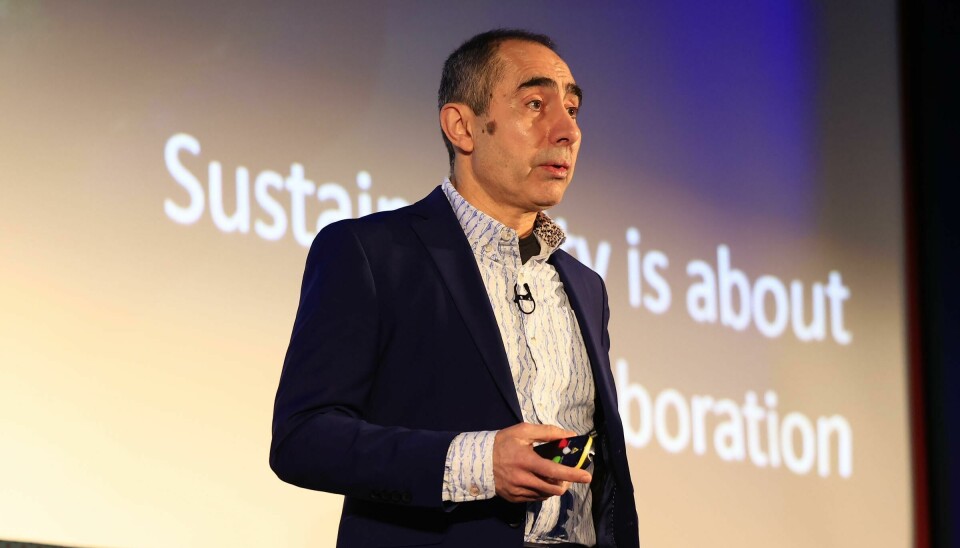
Levent Yuksel, freight operations director at JLRALSC Europe 2026
"There is no one solution fits for
all," Yuksel said. "If you are only fixed on one solution, then we
are restricting ourselves. So we are on an open mindset." In Europe, JLR
has progressed to 34% multimodal activity by cubic volume.
Advertisement
But when Yuksel mapped JLR's sustainability
activities across its network, what appeared were bubbles - localised successes
in Eastern Europe, the UK and Northern Europe - not an integrated end-to-end
solution.
An attempt to move goods from Europe to the UK
by rail failed. EV truck integration remains at very low scale. And regulatory
fragmentation across European states means a sustainable transport solution
that works on one corridor leg cannot legally continue into the next. "As
an ecosystem, as partners, we are not thinking in a holistic and end to end
view," he said. "We are just looking at some small patches."
Westermark brought a similar calculation. Volvo Group set a
target to reduce logistics emissions by 30% by 2025. The actual result was 22%.
"I must say I'm still super proud of the team that we reached this,"
she said. "It hasn't been an easy journey but we still missed with some
percentage points."
The primary gap was the US, where Volvo is a
large player in North America, and electrification there has not advanced at
the pace needed to close the shortfall. By 2030, the target is 50% reduction.
Getting there will require solutions across road, sea and air simultaneously,
and with a level of collaboration the industry has not yet fully mobilised.
From the shipping side, Muratbegovic reported that the company's 130
RORO vessels now run on 30% biofuel, up from effectively zero only a few years
ago.
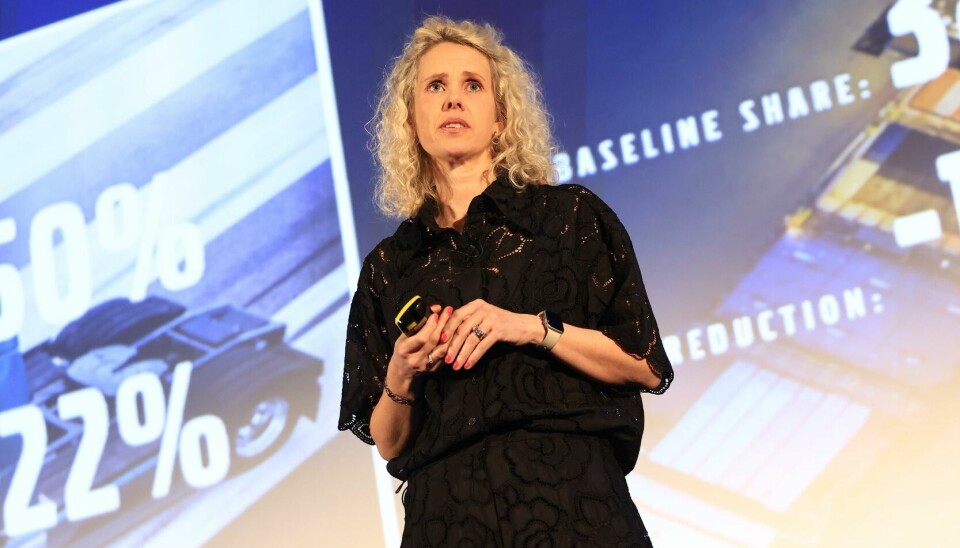
Jenny Westermark, senior vice president of logistics at Volvo GroupALSC Europe 2026
"You could look at it and say it's still
70% on diesel," he acknowledged. "Yes. But it's also 30% more than we
were at only a couple of years ago." New shaper class vessels coming into
the fleet are being built biomethanol-capable and ammonia-ready, with
retrofitting options built in - more flexibility than any previous generation
of vessels.
A net zero commitment by 2040 is in place,
with fuel recovery mechanisms available to customers. "The really
encouraging part is that solutions are there. We're not talking about
hypothetical solutions anymore," Muratbegovic said. "Affordability is
still something we work on very hard every single day."
What collaboration actually looks like
Advertisement
Westermark's green corridor case studies were
the clearest proof that the specific operational innovations that are moving
the needle can be made to work. Volvo Group is currently running two green
corridors in Europe - one in France covering over 700 kilometres, one in Sweden
running from Gothenburg to Stockholm.
Rather than starting with easy flows, Volvo
chose to run its most complex, time-critical material through these corridors
first. "We have taken the just-in-time flows," Westermark said.
"Today in our two green corridors in France and Sweden, we are
transporting engines, axle gearboxes and cabs. If you don't get those parts on
time to our plants, they are not producing."
The model uses relay driving where drivers
complete one leg and return home, the next driver takes over, and the vehicle
runs in multiple shifts around the clock. This solves the utilisation problem
that makes the business case for electric trucks viable. In the Swedish
corridor, Volvo co-loads with a supplier that has no direct relationship to its
transport network, allowing them to take one leg of the unbalanced return flow.
"I have nothing to do with their flows," Westermark said. "But
they were very keen on exploring this with electric vehicles." The result -
vehicles running 24/7, carriers commercially viable, and one driver telling
Westermark that the transition to electric trucks meant he could work another
ten years.
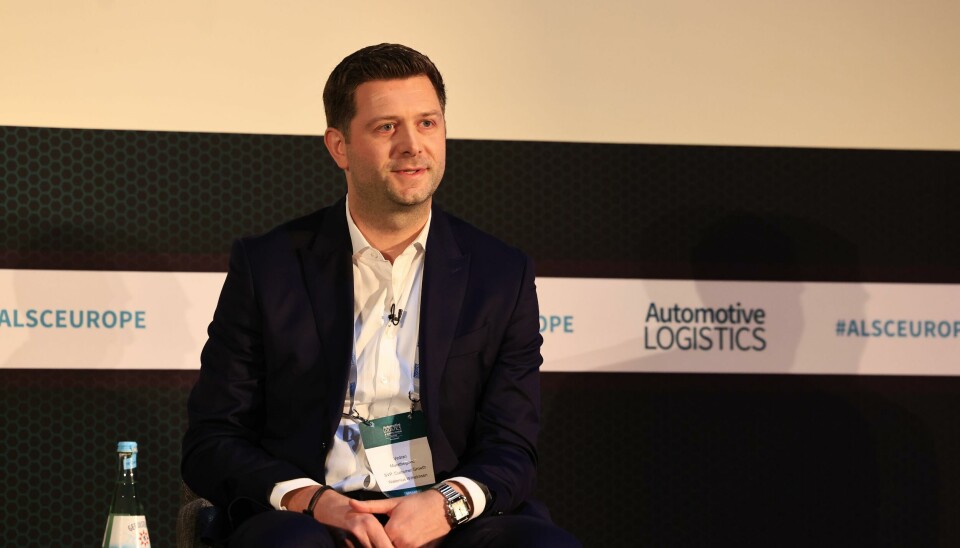
Vedran Muratbegovic, SVP of customer growth at Wallenius WilhelmsenALSC Europe 2026
Yuksel described a comparable model at JLR: a
three-party collaboration in which JLR bridged its inbound freight provider and
its finished vehicle distribution provider, two companies with no prior
relationship, enabling both to advance on sustainability through shared network
logic neither could have created alone.
The cost and partnership model behind all of
this was the panel's most essential debate. Muratbegovic stated that
traditional tendering, procurement cycles and annual contracts will not deliver
the transition at the required pace.
"It's with strategic partners that's
starting to change," he said. "We need longer term commitments and
co-investment. We need to be in it from both sides. That is absolutely
imperative if we are to get there by 2040."
Westermark described how Volvo approaches this
in practice involving sitting down with major carriers, opening the books,
agreeing on where the waste is and attacking it together. "We need to
assure that we create something win-win for us together," she said.
"And I mean the starting point is to acknowledge that there is a lot of
waste in our industry."
Advertisement
On contract length, Yuksel acknowledged the uncertainty
- electric truck economic lifespans are not yet well understood, RORO vessels
last 25 to 30 years - and yet both OEMs and carriers need a planning horizon
long enough to justify the investment. "I want to understand from Jenny, I
want to understand from Vedran, what works for them. And maybe it works for us
as well. Then how do we make this work?," he asked.
Westermark also outlined a book and claim
credit model Volvo is developing with two carriers — a mechanism that would
allow carriers investing in EV equipment to claim credits from customers who
cannot directly use green transport on every leg. "It's a little bit like
Booking.com," she said. "We need to have a way to co-load and by that
share the credits." The system is still in development, being piloted with
two carriers, but Westermark expressed confidence that something like it needs
to be operational within the next year.
With the current Middle East crisis driving
fuel prices higher, the question arises on how sustainability can remain a
priority. To this, Yuksel responded, "It is a kind of wake-up call to the
whole ecosystem that diesel is not cheap and cheerful for good.” “Although what
is happening over there is so heartbreaking, and we don't need a crisis to
really get the understanding and the awareness. But these moments are a good
wake-up call that we need to build on."
He was specific about what JLR needs. The
company's manufacturing footprint runs from the UK at the westernmost end of
Europe to Nitra in Slovakia at the eastern end, crossing eight to ten countries
plus the Channel.
Having a green corridor for JLR is a continent-wide
infrastructure challenge. His survey work found that the logistics community
does not believe TEN-T corridors are currently enabling genuine long-haul green
activity, primarily due to infrastructure availability gaps.
His suggested putting flows on the map, sharing
a trailer and creating the two-way flow that makes the business case for
alternative fuel equipment viable. "I can share my load and I can make one
way of the flow work, and then maybe they can put their load into the return
loop. That can generate a business case for the investment."
Westermark's argued that ideas need to be
pitched specifically and not at a high strategic level, but with enough shape
that the parties can actually act on them. "What can we do and what can we
do together?”
Muratbegovic's closing point was to focus on
engagement. "Continue this discussion, continue engagement, increase
engagement. We heard a lot today about co-development, co-investment. It is not
going to come to us without that," he said.
The session's final conviction, shared across
all three speakers, was that sustainability and competitiveness are not in
opposition. "Smarter, competitive logistics done sustainably and
collaboratively," Yuksel said, "becomes a strategic advantage."